Skip to Content

FEDERAL MEASURES MAKE IMPACT ON VICTORIA REAL ESTATE MARKET

VICTORIA, BC—While prices held steady through most of the Greater Victoria region’s real estate market in October, government lending regulations have had the desired “cooling effect” on year-over-year sales numbers.

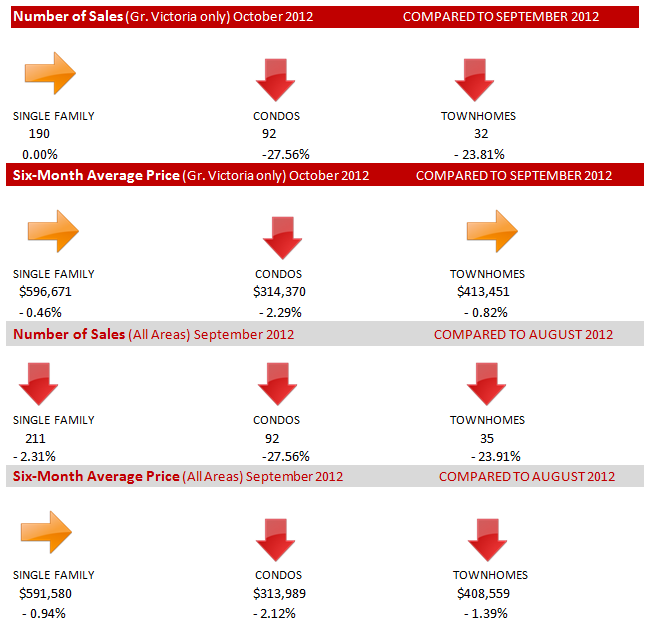
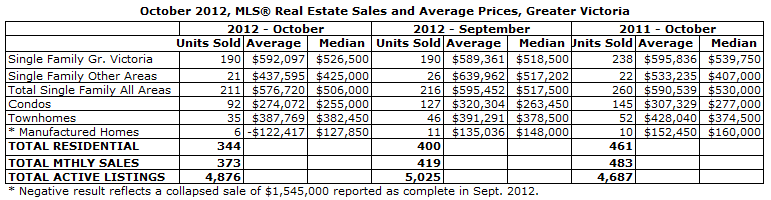
Total MLS® sales for October 2012 were 373 compared to 483 in October 2011. During the month, 211 single family homes sold throughout the Victoria Real Estate Board’s region, compared to 260 in October 2011. The average price for single family homes was $576,720, down 2% from last October’s average of $590,539. The median price for the same period is down $24,000 (4.5%).  Month-over-month, both sales volume and the six-month average for single family homes are flat. Active listings are 4,876. 

“Overall sales for Greater Victoria are down 19%,” says Carol Crabb, President of the Victoria Real Estate Board. “Federal measures to slow real estate sales nationally are having a local affect. Our REALTORS® tell me that with the reduced amortization rates, many buyers are having trouble getting financing for the type of home that fits their needs, particularly first-time buyers.”

Crabb also notes that there are fluctuations across the region. Sales and prices are flat in the Core Municipalities, while sales are down on the Saanich Peninsula, with declined sales and prices on the Westshore. “I strongly caution against reading too much into the numbers,” she says. “Both activity and prices vary by sub-area. For some the sample size is always small, so a sale of one or two properties can result in a 50% change.”

There were 92 condominium sales last month, 37% fewer than during October 2011. Six manufactured homes sold compared to 10 during the previous October. Townhome sales declined 37% and the average price dropped from $428,040 to $387,769, a 9% decrease.

Total Waterfront Single Family Dwellings sold:                      15, up 3 from 2011

Total Non-waterfront Single Family Dwellings sold:              196, down 52 sales from September 2011

Single Family Dwellings sold over $1 million:                           11 (1 over $2 million, 1 over $3 million)

Stats Quick Reference

Total Single Family All Areas includes Shawnigan Lake/Malahat, Gulf Islands and Up Island

Summary Report and Graphs

Monthly Sales Summary

Average Selling Price Graphs

Active Listings, New Listings and Sales Graphs

While the use of average price information can be useful in establishing trends when applied over a period of time, e.g. six months or longer, the Victoria Real Estate Board cautions that an average price does not indicate the actual value of any particular property. Those requiring specific information on property values should contact a REALTOR®.

Paying Off Your Mortgage Faster – 10 Quick Tips

Don’t waste your hard-earned money on interest!

These methods have allowed many people to shorten their mortgage life by years in a very short period and enjoy a greater lifestyle for a longer period.


One of the highest financial priorities of Canadian homeowners is to pay off their mortgage as quickly as possible. Paying down extra principal in the early years can shorten the life of your mortgage — and dramatically lower the interest you’ll pay over the long haul. “Pay-Off Tips” below describes some of the most effective methods of achieving this.


TIP #1: MORTGAGE  PAYMENTS  MADE WITH AFTER TAX CASH

More Canadians are becoming aware that since mortgage interest is not tax-deductible in Canada you are making mortgage payments of both principal and interest with money that you’ve already paid tax on — “after tax dollars”. This makes it even more important to eliminate the drainage of disposable income as soon as possible!


TIP #2: PREPAYMENTS GIVE GREAT RETURN ON INVESTMENT

For example,  if you pay an average of 4% in mortgage interest, for each $1,000 by which you reduce your mortgage principal, you will save $40 in after tax cash every year. If you are paying taxes at a marginal rate of 40%, you have to earn $66.67 each year to pay the interest on every $1,000 of principal outstanding…a heavy burden, but also a tremendous implied benefit to reducing this balance. In fact, the example shows that the “return on investment” for making prepayments on your mortgage is 6.67% before tax and 4% after tax — far better than most fixed return investments (bonds,  GICs, etc.).


TIP #3: INCREASE YOUR PAYMENT ANNUALLY TO THE MOST YOU CAN AFFORD

The upside is that most lenders will allow you to reduce it again to the previous level if it turns out to be too great a burden or your circumstances change.


TIP #4: UTILIZE YOUR RRSP-DRIVEN TAX REBATE AS A MORTGAGE PREPAYMENT METHOD Even if you can only prepay annually, make sure these funds are set aside for that purpose. Many Canadians will borrow (at prime) to buy  an RRSP to ensure the maximum rebate. When applied to the mortgage principal, this refund is a “gift that keeps on giving”. Combining the refund with the tax-free interest earned on the RRSP over  the subsequent years will quickly outpace the short-term interest costs of the RRSP loan.


TIP #5: INCREASE THE FREQUENCY OF YOUR PAYMENTS

Make accelerated bi-weekly payments to get a “free” principal reduction equivalent to one full mortgage payment every year — painlessly. Unless you are paid weekly it makes little sense to make weekly payments. All you’d be doing is making a smaller payment, and deferring the difference for a week.


TIP #6: MAKE USE OF DOUBLE-UP PRIVILEGES WHEREVER POSSIBLE

Tell yourself that you will “skip-a-payment” whenever necessary… then skip only when you absolutely must.


TIP #7: ROUND YOUR PAYMENTS UP

By adding even a nominal amount of say, $10 per payment, the amount of interest you are saving will be unbelievable, and the extra money relatively painless to part with.


TIP #8: PAY A LUMP SUM WHENEVER POSSIBLE

By decreasing the principal of the mortgage, your payments will not be allocated as much to interest in the future, thereby accelerating your freedom to mortgage-free life.


TIP #9: KEEP PAYMENTS THE SAME WHEN MORTGAGE RATES HAVE FALLEN

If the payment amount has not been a problem so far, then keep it the same thus paying down the principal faster.


TIP #10: RAISE PAYMENTS IN LINE WITH INCREASED INCOME ON AN AFTER-TAX BASIS

If your income increases, don’t keep your mortgage payments the same. Although the disposable income may be fun to spend on unnecessary luxuries in the short-term, the long-term benefits of being mortgage free faster and saving those interest payments will far outweigh the short-term curtailing — just pretend that your income did not increase and maintain your usual lifestyle.

Bank of Canada Interest Rate Announcement – Oct 23, 2012

The Bank of Canada once again opted to hold its target for the overnight rate at 1 per cent this morning. Interest rates have been held constant for over two years, the longest such period since the 1950s.The Bank somewhat tempered its bias for higher future interest rates, including a softer statement regarding the appropriateness of a gradual withdrawal of monetary stimulus as excess supply in the economy is absorbed. In a bit of a surprise, the Bank actually raised its forecast for the growth in the Canadian economy this year to 2.2 per cent, but kept its 2013 forecast at 2.3 per cent growth. The Bank judges that at that pace of growth, the Canadian economy will return to full capacity by the end of 2013.
It is our view that monetary policy at the Bank of Canada will continue to be constrained by external events in the global economy and household debt growth at home. While the Bank’s preference for tighter policy is clear, it is difficult to make a case for higher interest rates when core inflation is below the Bank’s 2 per cent target and already slow economic growth is threatened by global uncertainty. Therefore, we are forecasting that the Bank of Canada will hold its target overnight rate at 1 per cent until mid-to-late 2013 when, conditioned on an improved global economic outlook,  it may test the water with a 25 basis point rate increase.


The British Columbia Real Estate Association (BCREA) represents 11 member real estate boards and their approximately 18,000 REALTORS® on all provincial issues, providing an extensive communications network, standard forms, economic research and analysis, government relations, applied practice courses and continuing professional education (cpe).


To demonstrate the profession’s commitment to improving Quality of Life in BC communities, BCREA supports policies that help ensure economic vitality, provide housing opportunities, preserve the environment, protect property owners and build better communities with good schools and safe neighbourhoods.


For more information about organized real estate in British Columbia, follow these links:

Victoria’s Real Estate Market – Show Me The Beef!

I attended the Annual Victoria Real Estate Board election meeting this week where Cameron Muir, Chief Economist of BC Real Association spoke. He had some strong, positive news to report and feels the media and news are exaggerating some of the declines these past few months and feels as we head into 2013 we will see about 2% increase in prices within Victoria, after only a  3.5% drop so far this year on average prices (keep in mind higher-end properties and townhouses/condominiums have seen some larger declines).

Cameron quoted three strong economic factors that are at play which in his opinion, won’t lead us into a recession or real estate bubble within Canada and the Province:

 1.            Strong full-time job reports within BC and especially that  12,000 full-time jobs were created even though 5,000 part-time jobs lost, but it’s been the highest number of full-time positions created during the past decade! This is good, solid underpinning heading into the housing market next year if buyers have jobs, feel secure and can qualify for credit.

2.            Population growth is continuing on par over the past few years and not declining as it did in the 90’s. We have 4.5M people in the Province with the boomer population coming in a big wave soon and Victoria and the Island still targeted as their preferred retirement communities to relocate to.

3.            Interest Rates are continuing to be at historic lows, with only small incremental increases coming but not in the immediate future. The news these days and last weekend’s National Post quoted a story about Canadian household debt climbing but Cameron cautions the statistics don’t paint the entire picture and that if the averages they are using over the past 25 years should be factoring in the average 5 year mortgage rate which is 10%: right now we are no where near that level of interest rate. He is not concerned and especially that 2011 had some dismal employment stats but 2012 and heading into 2013 can only improve these numbers and confidence in the market. He also said stats show after credit tightening there is a pattern of decline and then an upward trend and we saw that in 2006 and if the same is true present day, we have seen most of the fall out of this past spring’s Federal government policy changes.

 Although there are still some major headwinds the Canadian economy is facing with global and US problems, it would take a major macro economic shock (i.e. recession, sharp increase in unemployment and household financial credit stress over a vast number of homes) for us to see some major declines in pricing within the Canadian housing market and within BC. Our Canadian economy is still “2 steps forward, 1 step back” and will finish the year like that.  Cameron showed an interesting slide in his presentation with the statistic for sales-to-active listings throughout the Province and Victoria ranked second at 12% which is a very strong showing.  

Another positive indicator is BC’s exports are so diversified especially in comparison to Alberta and Ontario who rely to heavily on the US and this has already helped stabilize the Province. In his opinion, he forecasts a continuation of flat, moderate pricing over the next 1-3 years, with no dramatic increases or drops. Cameron said “show him the beef” from the critics who are quoting the “sky is falling in” and “prices are going to drop 20, 30 to 50%” and the housing market is going “hell in a handbasket” – his economic factors and principals just don’t support these theories or comments.

At the end of the meeting, the Victoria Real Estate Board of Directors for 2012-13 was announced and I am proud to be part of such a professional, committed and forward-thinking Association of Realtors!

Victoria Real Estate Board of Directors 2012-13

If you have any questions or comments we always encourage feedback and look forward to hearing from you ~ Ingrid @ingridjarisz.com

Victoria Real Estate Market at a Standoff as Prices Remain Steady

VICTORIA BC – REALTORS® across Vancouver Island are experiencing a “wait and see” attitude amongst buyers and sellers alike. The result? Prices remain steady but sales numbers are down in some categories.

Total MLS® residential sales for September 2012 were 400 compared to 435 in September 2011. During the month, 216 single family homes sold throughout the Victoria Real Estate Board’s region, just 28 fewer than the 244 sold in September 2011. The average price for single family homes sold in Greater Victoria last month was $589,361, down from September 2011’s average of $622,393. The median price is down by $16,500 to $517,500 over September 2011. There are 5,025 active listings.

Graphical representation of recent sale counts and average prices

“We are at a bit of a standoff in the Greater Victoria real estate market,” says Carol Crabb, President of the Victoria Real Estate Board. “Buyers are waiting for prices to go down, but there are no economic indicators to show that will happen. Sellers are pricing their properties reasonably for the current market, which is reflected by the fact that single family homes are selling for an average 96% of list price and the average days on market remains 64.

“The median price of a single family home is only 1.5% lower than last year and that number has held steady for the last five months,” Crabb says. “Interest rates are also holding, but should they increase by as little as 1%, that would negate a 10% drop in purchase price. People shouldn’t wait for prices to drop, because we never know when interest rates will be increased to stimulate the economy.”

Condominium and manufactured home sales are virtually unchanged over September 2011 (approximately 1% each), while townhomes sales have declined 10%.

Total Waterfront Single Family Dwellings sold: 18, up 7 sales from 2011 Total Non-waterfront Single Family Dwellings sold: 198, down 35 sales from September 2011 Single Family Dwellings sold over $1 million: 14 (0 over $2 million).

Tablular representation of sales statistics from the last two months and from last year

Summary Report and Graphs

Monthly Sales Summary Average Selling Price Graphs Active Listings, New Listings and Sales Graphs

A STEADY, FLAT REAL ESTATE MARKET CONTINUES IN GREATER VICTORIA

VICTORIA, BC— The August real estate market continues to be steady and flat, considered by the Victoria Real Estate Board to reflect the “wait and see” attitude its Member REALTORS® are hearing from the buying public.

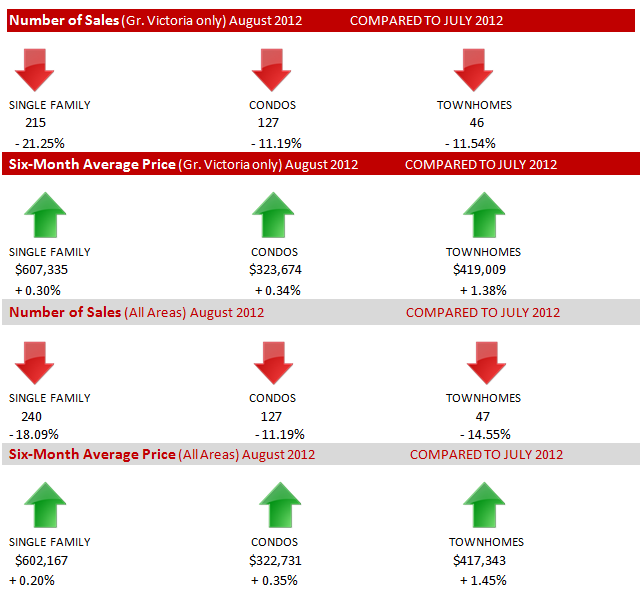
Total MLS® residential sales for August 2012 was 462 compared to 542 for the same period in 2011. During the month, 240 single family homes sold throughout the Victoria Real Estate Board’s region, 67 fewer than the 307 sold in August 2011. The average price for single family homes sold in Greater Victoria last month was $590,843, down from August 2011’s average of $652,841. The median price is down by $17,000 to $530,000. There are 5,034 active listings.

 “Sales are down 11.5% over August 2011” says Carol Crabb, President of the Victoria Real Estate Board. “When seasonally adjusted, there is little change from July 2012. It’s a flat market which we suspect will continue for the next few months and not trending in either direction.”

The overall provincial outlook is strong, with employers replacing part-time positions with full-time, and ongoing low interest rates. The British Columbia Real Estate Association predicts the resulting consumer confidence will move the provincial economy from flat to strong in 2013.

 Other categories are also holding steady. Condominium and manufactured home sales are virtually unchanged over August 2011, while townhomes sales continue to be softer.

 Total Waterfront Single Family Dwellings sold:                              25, down 3 sales from 2011

Total Non-waterfront Single Family Dwellings sold:                       215, down 64 sales from August 2011

Single Family Dwellings sold over $1 million:                                 10 (1 over $2 million)

Tablular representation of sales statistics from the last two months and from last year

Total Single Family All Areas includes Shawnigan Lake/Malahat, Gulf Islands and Up Island

Summary Report and Graphs

Monthly Sales Summary

Average Selling Price Graphs

Active Listings, New Listings and Sales Graphs

Stats Quick Reference


Demographic Shifts Not as Bad for Housing as Perceived: CIBC

Demographic conditions in the next decade will be as supportive as in the past decade – and might soften housing correction

TORONTO, Aug. 23, 2012 /CNW/ – Housing market activity is projected to soften in the near-term, but the good news is any adjustment will not be aggravated by negative demographic forces. In fact, at least for the next decade, demographic forces will be strong enough to mitigate the damage and probably shorten the duration of the upcoming market adjustment says a new report from CIBC World Market Inc.

“It turns out fears of a long and sharp down turn in the housing market are highly exaggerated and very premature,” says Benjamin Tal, Deputy Chief Economist at CIBC. “In fact, demographic forces will be supportive to real estate markets in the coming decade.”

The report notes that that the correction and subsequent stagnation in the housing market in the 1990s was accompanied by a notable softening in demographically based housing demand with average annual growth in demand slowing from well over two per cent in the late-1980s to an average of close to 0.2 per cent during the 1990s. That reflected the impact of the recession and the jobless recovery on population growth mainly via out-migration and a notable reduction in the number of new immigrants during that period. Assuming that any upcoming adjustment in housing market activity will occur in a non-recessionary environment, demand for housing in the coming decade should be more than four times stronger than it was during the dreary market of the 1990s.

Mr. Tal writes in his Consumer Watch report that while there will be a decline in the number of Canadians under the age of 25 and those between the ages 45 and 54, those age groups account for a relatively small portion of Canadians looking to buy a new home.

However, the number of Canadians between the ages of 25 and 34, the age group that makes up the vast majority of first-time buyers, will continue to grow.

“From a housing market perspective, what counts is not only the change in population of a given age group, but more importantly, the level of housing market activity among those groups,” says Mr. Tal. “In other words, the group that is most likely to buy a house will grow faster in the coming decade.”

Overall Mr. Tal says the next decade will see an annual population growth of 0.9 per cent, in line with growth seen in the past decade.

Growth in the housing market could be even stronger due to immigration. Mr. Tal notes that most of the growth in population is now due to immigration and it is clear that public policy on that front will be a major force that will impact housing demand. It is likely the actual pace of immigration growth in the next decade will be faster than currently projected due to changes in immigration policy.

“What’s more, there is significant jump in the home ownership rate among immigrants as they pass the three-year mark. In fact, after 10 years in Canada the propensity among immigrants to own a house is higher than among native born Canadians,” says Mr. Tal.

The report also tackles the issue of potential downsizing by Canadians aged 55-75 – suggesting that less than one third of households at that age group actually downsize and this number could be even lower in the next decade as baby boomers have more financial assets and tend to be in better health than previous generations.

Putting all this information together, little change in demand relative to the past decade and the increased supply due to downsizing and liquidation, it appears that any extra supply of housing due to demographic forces will be trivial at best and can be easily dealt with through a marginal reduction in housing starts.

The complete CIBC World Markets report is available at: http://research.cibcwm.com/economic_public/download/cw-20120823.pdf

CIBC’s wholesale banking business provides a range of integrated credit and capital markets products, investment banking, and merchant banking to clients in key financial markets in North America and around the world. We provide innovative capital solutions and advisory expertise across a wide range of industries as well as top-ranked research for our corporate, government and institutional clients.

SOURCE: CIBC – Investor Relations

For further information:

Benjamin Tal, Deputy Chief Economist, at416-956-3698, benjamin.tal@cibc.ca

Activity Continues in Favourable Victoria Real Estate Market Conditions

VICTORIA BC – Real estate activity continues to be steady in Greater Victoria, reflecting favourable conditions attributed to stable pricing, low interest rates and good selection.

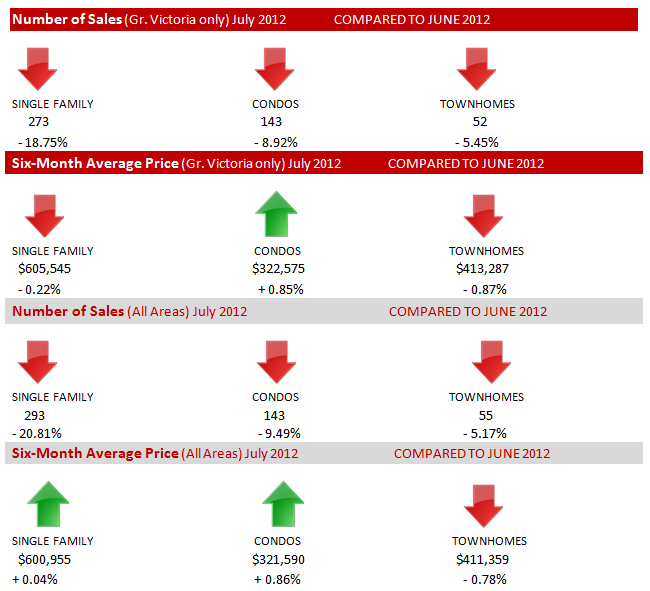
Total MLS® sales for July 2012 were 523 compared to 523 for the same period in 2011. During the month, 293 single family homes sold throughout the Victoria Real Estate Board’s region, on par with the 283 sold in July 2011. The average price for single family homes sold in Greater Victoria last month was $580,563, up slightly over July 2011’s average was $574,717. Of note, the median price varies by only $100 year over year. There are 5,178 active listings.

“The market is holding steady, reflecting that good properties that are priced well are selling,” says Carol Crabb, President of the Victoria Real Estate Board. “Combined with lots of selection and low interest rates, buyers have good opportunities to buy real estate in the Greater Victoria market. The downward adjustment in volume follows our historical cycle as we transition from a spring to summer market.”

Other categories are also holding steady. One variation is that condominium average and median prices are slightly higher, likely resulting from new product on the market.

Total Waterfront Single Family Dwellings sold: 14, down 5 sales over July 2011 Total Non-waterfront Single Family Dwellings sold: 279, up 15 sales over July 2011 Single Family Dwellings sold over $1 million: 14 (1 over $2 million)


Stats Quick Reference

Total Single Family All Areas includes Shawnigan Lake/Malahat, Gulf Islands and Up Island

Summary Report and Graphs

Monthly Sales Summary Average Selling Price Graphs Active Listings, New Listings and Sales Graphs

SECOND QUARTER OF 2012 GREATER VICTORIA REAL ESTATE MARKET CONTINUES SLOW GROWTH

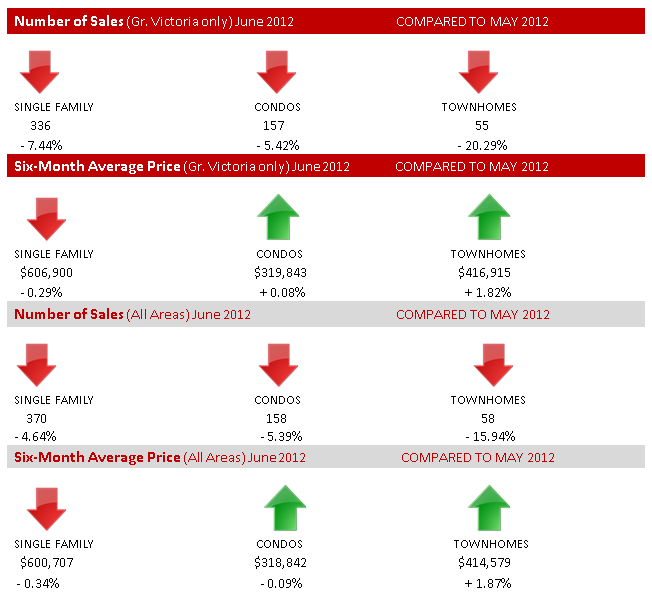
Last month 370 single family homes sold throughout the Victoria Real Estate Board’s region, whereas 348 sold in June 2011. The average price for single family homes sold in Greater Victoria last month was $580,557, a decrease from June 2011’s average of $618,429.It’s been a typical spring market in Greater Victoria real estate with good volume but average prices lower than a year ago.Total MLS® sales for June 2012 was 637, with 602 of those residential, compared to 618 and 596 respectively for the same period in 2011, and 659 and 636 last month. There are 5,189 active listings.”For our market, an average month is 500 sales,” says Carol Crabb, President of the Victoria Real Estate Board. “Volume during the last three months has been well ahead of that number.”Residential sales increased in the Second Quarter of 2012 over the same period in 2011. House sales in Greater Victoria totalled 993 over 924 for Q2 in 2011; 496 condos over 453 in 2011; 189 townhouses over 174; and 44 manufactured homes over 37.

Crabb notes, “For the quarter, average price are lower than last year: $608,072 versus the second quarter of 2011 at $624,773.

Total waterfront Single Family Dwellings sold: 16, down 8 sales over June 2011
Total non-waterfront Single Family Dwellings sold: 354, up 30 sales over June 2011
Single Family Dwellings sold over $1 million: 21 (3 over $2 million)

STATS QUICK REFERENCE

Total Single Family All Areas includes Shawnigan Lake/Malahat, Gulf Islands and Up Island

Summary Report and Graphs

Monthly Sales SummaryAverage Selling Price Graphs
Active Listings, New Listings and Sales Graphs

HARPER GOVERNMENT TAKES FURTHER ACTION TO STRENGTHEN CANADA’S HOUSING MARKET

Recently the Minister of Finance announced changes to the standards governing government-backed insured mortgages:

  • the maximum amortization period was reduced from 30 years to 25years;
  • the maximum amount Canadians can withdraw in refinancing their mortgages was lowered to 80 per cent from 85 per cent of the value of their homes;
  • the maximum gross debt service ratio was fixed at 39 per cent and the maximum total debt service ratio at 44 per cent; and
  •  the availability of government-backed insured mortgages was limited to homes with a purchase price of less than $1 million.
The Canadian Reall Estate Association (CREA) has continually stressed the need to avoid changing the minimum down payment. Today’s announcement confirms Canadians will continue to be able to purchase a home with five percent down.
The changes announced today will come into effect on July 9, 2012. Details of the announcement can be found here.
Of note, the Victoria Real Estate Board REALTOR® Market Survey shows that an average 23% of purchasers in Greater Victoria required insured mortgages in the first 5 months of 2012. Below are some FAQ’s that the Dept. of Finance Canada has set out, however if you have any questions, please don’t hesitate to contact any one of The MastersGroup for more information. 

FREQUENTLY ASKED QUESTIONS 
(From Department of Finance Canada)
Q. Why is the Government making these changes at this time?
A. These measures will support the long-term stability of the Canadian housing and mortgage markets and promote savings through home ownership. They are intended to be timely, targeted and measured. The measures will reinforce the importance of borrowing responsibly and using home ownership as a savings vehicle. The Government actively monitors developments in the housing market and is committed to taking action when necessary.
Q. What will be the impacts of the adjustments to the rules for government-backed mortgage insurance on the Canadian economy?
A. The adjustments to the rules for government-backed mortgage insurance will provide significant benefits to the Canadian economy by supporting the stability of the housing market and promoting savings through home ownership. The short-term impact on the housing market is expected to b
e manageable, given that the majority of Canadian families are already taking a prudent approach in managing household debts. In the long term, these measures are expected to have a positive impact on the economy through higher savings and a lower number of financially vulnerable households.
Q. When do these measures take effect?
A. The new measures will take effect on July 9, 2012.
Q. Are further measures expected?
A. The Government actively monitors developments in the housing market, consumer debt and the economy, and is committed to taking action when necessary to support the long-term stability of the housing market and protect the investment of Canadian families.
Q. Do these measures apply to multi-unit buildings?
A. These standards apply to mortgages on residential property with four units or less.
Q. Why is the Government lowering the limit on refinancing again?
A. The new measure announced today will reduce the maximum amount on refinancing to 80 per cent from 85 per cent of the value of the home. Limiting the amount of refinancing will promote saving through home ownership and limit the shifting of consumer debt into mortgages guaranteed by taxpayers.
Q. Why is the Government lowering the maximum amortization period again?
A. The new measure announced today will reduce the maximum amortization period to 25 years from 30 years. Limiting the maximum amortization period will reduce the total interest payments Canadian families make on their mortgages, helping them build up equity in their homes more quickly and pay off their mortgages sooner.
For example, reducing the amortization period from 30 years to 25 years on a mortgage would result in a moderate increase in the monthly payment. However, over the life of the mortgage, this modest increase would result in a significant reduction in the total interest payments. For a $350,000 mortgage at 4 per cent interest rate, the interest savings could be over $45,000.
Q. Why is the Government limiting the maximum gross debt service (GDS) and total debt service (TDS) ratios?
A. The GDS ratio is the share of the borrower’s gross household income that is needed to pay for home-related expenses, such as mortgage payments, property taxes and heating expenses. The TDS ratio is the share of the borrower’s gross income that is needed to pay for home-related expenses and all other debt obligations, such as credit cards and car loans.
The new measure announced today will set the maximum GDS ratio at 39 per cent and reduce the maximum TDS ratio to 44 per cent. These debt service ratios measure the share of a household’s income that is required to cover payments associated with servicing debt. Both measures are already used by lenders and mortgage insurers to assess a borrower’s ability to pay. Setting a GDS limit and reducing the TDS limit will help prevent Canadian households from getting overextended and reduce the number of households vulnerable to economic shocks or an increase in interest rates.
Q. Why is the Government introducing a maximum allowable price for insured mortgages?
A. The new measure announced today will establish that government-backed mortgage insurance is only available for a new high loan-to-value mortgage if the home purchase price is less than $1 million. Because homes priced at or above $1 million would not be eligible for government-backed high ratio insurance, borrowers for these homes would require a down payment of at least 20 per cent.
Introducing a maximum allowable price will ensure that government-backed mortgage insurance operates the way it was originally intended: to help working families and first-time homebuyers. This measure is expected to have a negligible impact on working families and first-time homebuyers as the vast majority of these borrowers purchase properties priced below the threshold.
CONCERNS ABOUT BORROWERS
Q. I already have an insured mortgage. How will these changes affect me?
A. Mortgage insurance is good for the life of the mortgage. Borrowers renewing their insured mortgages will not be affected by these changes. For example, if a borrower had a 30-year amortization and there are 27 years remaining on the mortgage, the mortgage can be renewed with a 27-year amortization, as long as no new funds are being added to the mortgage.
Q. What is required to qualify for an exception to the new parameters?
A. The new measures will apply as of July 9, 2012. Exceptions will be made to satisfy a binding purchase and sale, financing or refinancing agreement where a mortgage insurance application has been made before July 9, 2012. While the changes come into force on July 9, 2012, any mortgage insurance applications received after June 21, 2012 and before July 9, 2012 that do not conform to the measures announced today must be funded by December 31, 2012.
Q. Will a purchase and sale agreement dated prior to July 9, 2012 be considered binding if there are outstanding conditions that have not been fulfilled prior to July 9, 2012?
A. Yes, if the date on the purchase and sale agreement is earlier than July 9, 2012, and a mortgage insurance application has been made prior to that date, the new parameters will not apply, even if the conditions of the agreement have not been waived.
Q. Will the new refinancing rules allow a borrower with a mortgage above 80 per cent loan-to-value (LTV) to refinance by extending the amortization period?
A. No. Effective July 9, 2012, borrowers will not be permitted to refinance a mortgage above an 80 per cent LTV, unless the borrower has a binding refinance agreement dated prior to July 9, 2012, and a mortgage insurance agreement has been made prior to that date.
Q. I have a written mortgage pre-approval from a lender, dated before July 9, 2012 with a 30-year amortization. Will I still be eligible for a 30-year amortization if I don’t sign an agreement of purchase and sale until July 9, 2012 or later?
A. No, a mortgage pre-approval without an agreement of purchase and sale is not sufficient to qualify for a 30-year amortization. You may have a 30-year amortization only if your agreement of purchase and sale is dated before July 9, 2012 and you have made a mortgage insurance application before July 9, 2012. You may wish to discuss with your lender to revise your mortgage pre-approval using the new parameters announced today.
Q. Will the new parameters apply to assignment (“switch” or transfer) of a previously insured loan from one approved lender to another?
A. No. As long as the loan amount and amortization period are not increased, the new parameters will not apply to a switch/transfer/assignment of the mortgage to a different lender.
Q. If I sell my current home and buy another, will the new parameters apply if I transfer the outstanding balance of my insured mortgage to the new home?
A. As long as the outstanding balance of the insured loan, the LTV ratio and the remainder of the amortization period are not increased, the new parameters will not apply when the mortgage insurance is transferred from one home to another.
Q. What if I need to increase the amount of my insured loan when I sell my current home and buy another?
A. In this situation, the new parameters will apply for any insured loan.
Q. If I bought a condo that is not expected to be built for another two years, will the new parameters apply?
A. If you bought a condo and have made a mortgage insurance application on or before June 21, then the new parameters would not apply.
If you buy a condo and make a mortgage insurance application after June 21, the new parameters will apply if the mortgage loan is not funded by December 31, 2012.