Skip to Content

Spring – a time of renewal, rejuvenation & looking forward!

TreesToday marks the beginning of spring – a time of renewal, rejuvenation, and looking forward to the summer ahead.  Sante Spa at Bear Mountain offers five ways to make the most of the season and get ready for everything summer has to offer.

1)  Get Outside
As the weather turns warmer our thoughts naturally turn to the great outdoors. Now is the time to plan your garden, hike the trails at East Sooke Park or admire the tide pools at Botanical Beach. A 2009 study from the University of Rochester found that spending as little as ten minutes outside can have a positive effect on feelings of wellness and vitality.

2)  Celebrate the Earth
Consider what you can do to lessen your footprint. Little changes to conserve energy and reduce waste can go a long way. Try hanging your clothes to dry, bringing a reusable travel mug to your favourite coffee shop, or refreshing your wardrobe at a second-hand store.

3)  Let Go
Spring is an ideal time to reevaluate your life and let go of the aspects of your life that may no longer be working as they should. Perhaps it’s time to cut ties with a toxic friend, explore a career change or relocate to a different neighborhood.

4)  Nurture Your Spirit
Taking the time to care is rejuvenating. Spend some time with an old friend, paint, put on an old CD you haven’t listened to in years, or try one of our signature spa treatments.

5)  Rethink What You Eat
After a winter of potlucks, baked goods and parties now is the time to bring our focus back to a diet that focuses on the basics our bodies require. Replace pop with herbal teas, try fresh squeezed juices and be sure to make time for breakfast. Grandma was right – it is the most important meal of the day!

Located minutes from my new listing at 2168 Players Drive at Bear Mountain, the award-winning Sante Spa Victoria draws from the elements of nature to inspire, nurture and empower your wellbeing. Their full array of spa treatments offers endless opportunities for relaxation, discovery, renewal and spiritual awakening. Here you will experience nature’s escape through treatments that harness the therapeutic benefits of locally cultivated ingredients such as coastal sea kelp, northern clay, and lavender. Discover their signature treatments – created by and exclusive to Sante Spa Victoria. Botanical ingredients and indigenous elements are woven together to create a sensory journey that awakens one’s sense of contentment, self-awareness and wellbeing. Discover Sante Spa, Victoria’s Mountain Escape – the splendour of ancient arbutus groves amidst expansive views beckon you here – the calm embrace you experience will bring you back.

Sante Spa Victoria
1999 Country Club Way
Victoria, BC V9B 6R3
P. 250.391.3920

Victoria’s Feb 2013 Average House Price of $463,265 Is Virtually Unchanged From Feb 2012

BC Real Estate Association reports that February BC home sales continued at modest pace & pent-up demand is growing. Victoria’s February 2013 Average House Price of $463,265 is virtually unchanged from 2012’s average of $464,570 (down only -0.3%) and our listing volume has only increased 4% over February 2012 to 3,252 overall residential listings, even though sales volume has declined 20%. We are currently at 8 months supply with inventory.  “Despite improved affordability, many potential buyers and sellers remain in a holding pattern. With pent up demand now becoming latent in the market, it’s not a matter of if, but when home sales rise above their current pace”.

Shelly Mann, the President of the Victoria Real Estate Board says that there is nothing to be alarmed about for Victoria homeowners. “We expect prices to remain flat this year, we said that all along, it’s a transitional year for us.  They may even dip slightly, and we anticipate probably a 2% increase in value for the next two to three years.  So the usual growth, statiscally, is about 3.5%, and we’re not really that far off.  Especially after a period of such high gross.”

For the past 10 years Canadian home prices had seen a 7 percent annual price gain, a figure that is unlikely to be seen again for some time.

Cameron Muir, Economist, with BC Real Estate Association – Video Blog Here:   Housing Market Update (March 2013)

February 2013 Residential Average Price – Data by Real Estate Board Region


Sun up: Seven days of desert golf in Palm Springs, California

PALM SPRINGS, Calif. — There are 168 hours in a week. Can you devote 28 of those to golf?

Rancho Las Palmas - West golf course

My husband and I discovered Palm Springs about 4 years ago when we visited the first time using our Intrawest Time Share at Palm Desert and fell in love immediately! The warmth of the desert sun, beauty of the surrounding mountains and freshness of the air energized our short stay which included primarily lounging at the pool, shopping and dining. Fast forward 3 return trips in 3 years, and lots of practice at the driving range, our last trip ringing in the New Year at the Marriott Desert Springs finally included golf! I thought I was hooked with the shopping and dining, but the golf experience we enjoyed had us book our next trip down to celebrate our 25th wedding anniversary the day after our return home in January! My first time golfing both Desert Springs and Desert Willow were so exhilerating and enjoyable, even with some errand shots and high scores. Don’t wait to explore this amazing city and all that it has to offer. Most of those who know me will often hear me talk about my favourite spots and things to do in PSP – I’m always up for desert talk!  Here is a Blog post I came across and gives you some great options to book those tee times amongst all of the other fun things to do and see in Palm Springs. Enjoy and Good Golfing!

Home to nearly 125 golf courses, Palm Springs and the Coachella Valley offer no shortage of options for players seeking variety in setting and challenge. Whether you’ve got the legs for seven consecutive days of play or are simply seeking to intersperse a few rounds amid the wealth of desert activity, here’s a list that can satisfy players of all skill levels. Like the leviathan mountain backdrops that define the region, the list is a slow, steady climb that goes from casual tests to vigorous challenges.

Palm Springs golf trip: Day 1

Start you week in the proper gear with a highly playable round at Rancho Las Palmas in Rancho Mirage. Home to 27 holes (request the South-West rota if you can), the welcoming, centrally located Ted Robinson designs are perfect for gearing up the mid-iron play that will serve you well over the course of the week.

Palm Springs golf trip: Day 2

Segue from resort grounds to the spare beauty of Desert Dunes Golf Club in Desert Hot Springs. Few courses in the area offer the tranquil setting of this Robert Trent Jones Jr. design, which expertly evolves in landscape from an open front side to a latter nine layout with more defined routing.

Short, engaging par 4s define the card at Desert Dunes, which is best to play in the morning before west valley winds find opportunity to oscillate your ball.

Palm Springs golf trip: Day 3La Quinta resort - Mountain golf course

Maintain those sensibilities of setting by moving across the valley to La Quinta Resort & Club and PGA West. Nine courses (including five public) sprawl across “The Western Home of Golf America,” boasting an all-star cast of designers and no shortage of variety.

The third day will be best defined with a round at Pete Dye’s Mountain Course. While the initial nine may elicit a few, “Um, this doesn’t look like the photos I saw,” rest assured that the transition to the back segues to some of the desert’s most stirring topography by No. 12.

Palm Springs golf trip: Day 4

Spend the entirety of the day at Marriott’s Shadow Ridge in Palm Desert, where superb practice facilities match one of the valley’s most unique courses.

Arrive early to make ample use of the pitching range and spend time post-round doing the same on the full range. Between such polishing, enjoy Nick Faldo’s first domestic design, where aggressive bunkering and ample green undulation awaits.

Palm Springs golf trip: Day 5Classic Club golf course

Stay in Palm Desert for and pencil in a visit to the Classic Club. Built to host the former Bob Hope Classic (now the Humana Challenge), the Arnold Palmer design plays across one of the desert’s most impressive (and aggressive) pieces of property.

Water is abundant here, appearing on 13 holes and regularly playing as a double-featured hazard beside/behind greens. The home hole is a par-5 beast from an elevated tee box that sports water all along the right of the fairway and putting surface.

Palm Springs golf trip: Day 6

If you’ve got the legs for a 36-hole day, spend it at either Indian Wells Golf Resort or Desert Willow Golf Resort.

Host to the Golf Channel’s “Big Break,” Indian Wells features the eye-catching water and color of the Celebrity Course and the more penal (though equally fetching), bunker-laden roll of the Players Course. Both tracks are immaculately sculpted and present some of the region’s most popular stops for style and challenge.

Desert Willow Golf Resort - Firecliff Course - hole 17The unparalleled desert routing at Desert Willow in Palm Desert plays across the Dr. Michael Hurdzan/Dana Fry-designed Mountain View Course and Firecliff Course. Like Indian Wells, one can’t go wrong with either. Start with the Mountain View before enjoying a patio lunch overlooking the grounds. Then segue your latter 18 to the more formidable Firecliff, which sports ample forced carry and consistently tough sand.

Palm Springs golf trip: Day 7

Conclude your desert week with the punitive pleasures of the Stadium Course at PGA West. This is the region’s most difficult test of skill and will. Tipping out at 7,300 yards (with a slope of 150), the Stadium Course doesn’t necessarily intimidate with grandeur — at least before the three finishing holes.

Rather, it’s Dye’s masterful land manipulation of consistent, albeit oft-subtle elevation changes, lurking water, side hill/uphill/downhill rolling lies and blocked pins that get in one’s head.

After seven days of golf, the truly driven will find no more formidable challenge. If you’re still getting warmed-up at this stage, the timid will find this baby an unwavering day of Stadium sweat and suffer.

Judd Spicer

Judd Spicer, Contributor

Judd Spicer is an award-winning, veteran freelance writer hailing from St. Paul, Minn. After 12 years of covering MLB, NBA, NCAA and the active golf landscape of the Twin Cities, he relocated to [ read more… ]the Palm Spring, Calif. region to further pursue his golf work and Champions Tour dream. Sporting measured distance off the tee, Spicer refers to his pitching wedge as his “magic wand.”[less]

Spring Perks Up Greater Victoria Real Estate Market

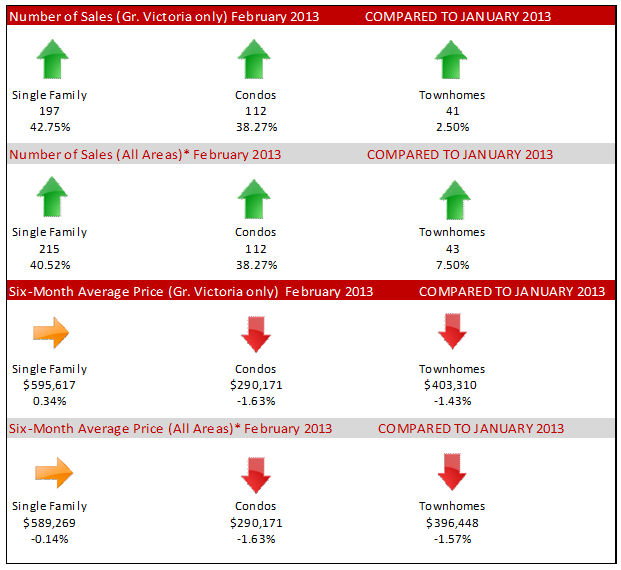
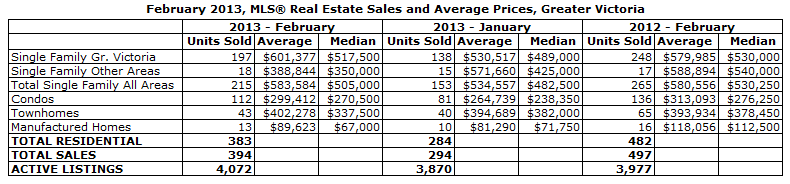
VICTORIA BC – The Victoria Real Estate Board reports a total of 394 sales were processed through the Multiple Listing Service (MLS®) in February, an increase of 34% over the previous month. The highest activity was in single-family homes and condominiums.

Compared to February 2012, sales were down by 18.26%. Shelley Mann, President of the Board, says it’s more important to look at monthly trends and compare monthly buying behaviour year-over-year. “The trend lines for November, December and January are the same for the last three years.

“We’ve seen a slow increase in sales activity over the last three months and we still hold to our forecast of a modest 2-4% sales increase in 2013,” Mann says.

“The typical spring market is perking up. I spoke to 10 REALTORS® yesterday and nine said they are experiencing definite increases in their activity over the last two months and have a positive outlook. Many buyers are still waiting for prices to drop, but it’s clear to me that sellers are in a holding pattern regarding the value of their homes,” Mann says. “However, if a house is priced properly, within the market value range, it will likely sell more quickly.”

The median price of a single family home is $505,500 compared to $530,250 in February 2012, a decrease of 4.67%. The six-month average shows an increase of less than one percent year-over-year, and a less than one percent decrease over last month. “In other words, no change,” Mann adds.

There were 112 condominium sales in February, a 38.27% increase over January 2013. While the median price of $270,500 for condominiums is down 2.08% year-over-year, it increased 13.49% over January 2013. Townhouses saw increased sales in the past month with a median price of $337,500, which is down by 11.65% year-over-year and 10.82% since January 2013. Current active listings at the end of February were 4,072.

Total Waterfront Single Family Dwellings sold: 12, up 5 over February 2012   Total Non-waterfront Single Family Dwellings sold: 203, down 55 sales from February 2012   Single Family Dwellings sold over $1 million: 11 (3 over $2 million)

Summary Report and Graphs

Monthly Sales Summary

Average Selling Price Graphs

Active Listings, New Listings and Sales Graphs

Sales Down but Prices Hold in Greater Victoria Real Estate Market

VICTORIA BC – A slow start to the year in Victoria’s real estate market is evidence that buyers are continuing to wait for prices to drop. Although January 2013 sales are 27% lower than January 2012, the six-month average price for a Greater Victoria home is only down 1% for the same period.

“We are realistic and sales are not what we would like to see,” says Shelley Mann, President of Victoria Real Estate Board. “But there are many stories within the market. This week, three houses sold in Sidney that were all newly listed and they sold for over asking price.”

Mann adds that she’s spoken to several local REALTORS® who have clients who want to buy, but they are looking for good houses with quality amenities. “One Member told me that he has several potential buyers, but they can’t find anything they like.”

In January, 294 properties sold, compared to 372 in January 2012. The median price of a single family home is $482,500 compared to $522,000, a decline of 7.6.%. The six-month average shows a 1.4% decline, year-over-year, but less than one percent over last month.

“My basic message is that sales are down, prices are flat and our provincial economist is predicting 2013 will be a transition year,” Mann says. “He believes the economic fundamentals are strong, and as a result the sales volume will increase 4% this year over 2012, but prices will remain flat.”

Current active listings are 3,870. There were 81 condominium sales in January, a 24.6% increase over December 2012, while the median price of $238,350 is down 12.1% year-over-year. Townhouses saw increased sales in the past month and a median price of $382,000, up 4.7% year-over-year.

Total Waterfront Single Family Dwellings sold: 9, up 5 over January 2012 Total Non-waterfront Single Family Dwellings sold:144, down 43 sales from January 2012 Single Family Dwellings sold over $1 million: 3 (1 over $2 million)

 Total Single Family All Areas includes Shawnigan Lake/Malahat, Gulf Islands and Up Island

Summary Report and Graphs

Monthly Sales Summary

Average Selling Price Graphs

Active Listings, New Listings and Sales Graphs

Preparing Your Home For Sale

Break out the mop and the paintbrush. It’s time to give your home a mini-makeover. I watched the new HGTV Show last night, Buying & Selling, with my two favourite Property Brothers, Jonathan and Drew Scott. I loved how honest they were with the homeowners about cleaning, de-cluttering and staging their home for sale.  Here is the episode if you want some excellent advice before you list your home! Also, here are all the little things you can do to attract the big offers.

See your home through a buyer’s eyes

Now’s the time to address your home’s little imperfections: the hole in the screen door, the chipped paint on the baseboards, and the mess in the basement. Print out a copy of our Is Your Home Ready? A Checklist and take a thorough tour of your home.

Get rid of clutter

Your house will feel a lot bigger and more inviting when you clear out those closets, remove bulky, unused furniture and rearrange the remaining pieces to make the best use of space. If you haven’t used something in the past year, toss it, donate it to charity or sell it.

Clean everything

Cleaning is the single most cost effective way to make your home more attractive to buyers. Floors, windows, walls, doors, baseboards – everything! Give extra care and attention to the bathrooms and kitchen. And once it’s all clean, keep it clean! You never know when your ideal buyer will visit.

Repair as much as you can, within reason

Some repairs are absolutely vital, like a leaky roof or basement and unsafe electrical problems. Otherwise, fix all the little things like leaky faucets, doors that squeak, and small cracks in the ceiling.

Depersonalize your home

You want buyers to walk through your house and feel like it’s their home, not yours! Things like a cluttered wall of family portraits or your trophy collection are guaranteed to prevent buyers from emotionally placing themselves in your home. Remove everything that’s too much about you.

Never underestimate the power of paint

Strong colours on the walls or wild wallpaper make it hard for buyers to imagine their furniture in your house. Consider repainting your home in bright, neutral colours that will enhance a room’s size and look more inviting. Next to cleaning your home, paint is the most cost-effective way to increase your home’s appeal.

Add some beautifying touches

You don’t need to spend a fortune to make a big difference. Replace tattered old curtains with some fresh draperies. Mirrors on the wall help rooms feel more spacious. New houseplants add undeniable appeal. And on the outside of your home trim the trees, weed the garden and consider planting a few new flowers to make a great first impression.

Weighing the cost of improvements vs. the potential return

Don’t get so carried away with prepping your home that you forget why you’re doing this – to get more money! You need to consider two things before making any improvements.

  1. Will this make my home more desirable to buyers?
  2. Will this increase the value of my home more than it costs me to do it?

Now I know that you have to live in the house while it’s on the market and not all of us (and I’m included in this group) live in a show ready home.  Kids, pets and parties all conspire to compromise the “showability” of your home.  However, if you keep things relatively picked up, it will hopefully be a quick job to make the place show ready when your REALTOR® calls to book a showing.

As a licensed REALTOR®, I am able to offer useful tips and advice when it comes to prepping homes. ~ Ingrid Jarisz

Retirement rationalizations: 6 misconceptions about RRSPs

By GoldenGirlFinance.com

The statistics are clear: most Canadians are not preparing for retirement. According to a new poll by CIBC, more than half of Canadians surveyed said they did not feel adequately prepared for this later stage of their lives. When we at GoldenGirlFinance.com published an article about the importance of investing in Registered Retirement Savings Plans (RRSPs), we were flooded with comments from readers on why they felt RRSPs didn’t work; some even suggested they were a government scam!

It seems that people have a lot of reasons for not investing in an RRSP, which might account for why only about one-third of Canadians make an RRSP contribution each year. The problem is, many common opinions about RRSPs are myths that just don’t stand up to reason. Let’s look at the facts behind the flak…

1) Taxes, taxes and more taxes

One of the most common objections to RRSPs is that they are taxed. Well yes, but so is pretty much every cent you earn. But the way RRSPs are taxed is a little bit different – and that’s what makes them beneficial for the vast majority of people.

You see, RRSPs are tax-deferred. So let’s say you make $50,000 per year in 2011 and deposit $3,000 into your RRSP. At $50,000 per year, a taxpayer in Ontario will owe about $8,900 in taxes. However, thanks to contributing to your RRSP, that amount will be reduced to about $7,800 or a savings of $1,084 (which often means you’ll get that money back in the form of a tax return). Think of it this way: the tax you paid is essentially being returned to you for contributing to your RRSP. Better still, that $3,000 contribution won’t be taxed until you withdraw it many years later as income for retirement, giving it more power to grow into a bigger lump sum.

[More: How to stay focused on your retirement savings in an uncertain market]

The real sweet deal: you are only taxed on this contribution once – when you take it out (and when you’ll likely be in a much lower tax bracket, meaning you get to keep more).

BONUS TIP: Reinvest that tax return. It’s like turbo-charging all of the above benefits!

2) Your tax rate

As previously mentioned, the general argument in favour of contributing to RRSPs and deferring paying tax on those funds is that many people will be in a lower tax bracket when they retire than they were during their working years. After all, if you are making $50,000 per year now, and you expect to retire at age 65, you will need to have more than $1 million dollars in your retirement fund to pay out that amount until you’re 90. For most people, that’s unlikely. This is why experts suggest your income will be lower during retirement. Of course, pensions and other retirement benefits count as part of your total income, so check with your tax professional to determine whether an RRSP is the best option for you.

3) The missing tax

When it comes to taxes, there’s one big thing that many of those who complain about the income tax on RRSPs are missing: RRSPs offer tax free growth on your investments. This benefit should not be ignored as an investor has the opportunity to avoid paying capital gains tax, and literally earn tax-free income within the plan for life. Therefore, regardless if you sell a winning stock, bank some interest on a GIC or earn a healthy dividend on your stocks, at the end of the year, you pay no tax.

So let’s say you have $5,000 that you want to invest. If you choose to leave it outside of an RRSP, you will first have to pay income tax. Then, if you realize a profit or earn income on that investment, you will be taxed on that as well – and that tax will be owed each and every year you crystallize a profit, earn a dividend or are paid interest thereafter. In other words, tax can absolutely cut into the overall returns on your investment. But with an RRSP, you get to skip that tax altogether, allowing the funds to grow undisturbed and tax free as long as they remain within the plan. You will only pay tax on money when you withdraw it, leaving the remaining funds in the RRSP to continue to grow tax free. Holding on to more of your cash? That’s a huge benefit not to be dismissed.

[More: Why you should contribute to your RRSP this year]

4) The markets

Another common complaint against RRSPs is how poorly they’re doing right now. It’s certainly true that the financial markets have not been kind to investors in recent years. The problem is, saying you’re not going to invest in RRSPs because the markets are poor is like saying you’re buying a new car because your current one has a flat tire. This is because an RRSP is a type of account, not a type of investment. What this means is you can put just about anything in it!

The reality is that stocks have disappointed investors many times in history. If the ebb and flow of the markets also makes your stomach ebb and flow, you can always invest in something more secure, such as a GIC.

[More: Why retiring with debt is a big deal]

5) RRSPs are your money

RRSPs are often confused with pensions and other types of retirement benefits, which, in the most dramatic cases, have been misspent or mismanaged, leaving retirees with little more than spare change. RRSPs are different in that they are your own money, just like the cash you deposit into your checking or savings account. It’s basically a savings account that you can use to invest in whatever you want, and which most importantly, allows you to defer the taxes until you retire. That’s a good deal!

6) No RRSP= No retirement savings?!

Possibly the biggest problem with RRSP bashing is that it often results in no retirement savings at all. Since Tax-Free Savings Accounts (TFSAs) were introduced in 2009, there’s been a lot of debate about whether they are a better option for some individuals. This is an issue that people should discuss with a qualified financial professional. However, many of the richest people in the world go to great lengths to reduce their tax liabilities for the simple reason that it has a huge effect on net worth. So whether you opt for a TFSA or an RRSP, it’s likely that a tax-advantaged savings vehicle can help you reach your financial goals. It’s really rather simple: why would you pay more tax than you have to?

So, will you contribute this year?

RRSPs are not for everyone, but for many people they provide a great option for retirement savings. Before you decide to skip out on this investment, take the time to get to know the facts about how they work. Whether you put your money into an RRSP, a TFSA or some other type of investment, don’t let misinformation keep you from getting the most out of your money.

GoldenGirlFinance.com is a free personal finance and education site for women.

Nothing contained herein is intended to provide personalized financial, legal or tax advice. Before implementing any financial strategy, you should obtain information and advice from your financial, legal and/or tax advisers who are fully aware of your individual circumstances.

Focus: RRSP »

2012 Ends on a Steady Note for Victoria Real Estate Market

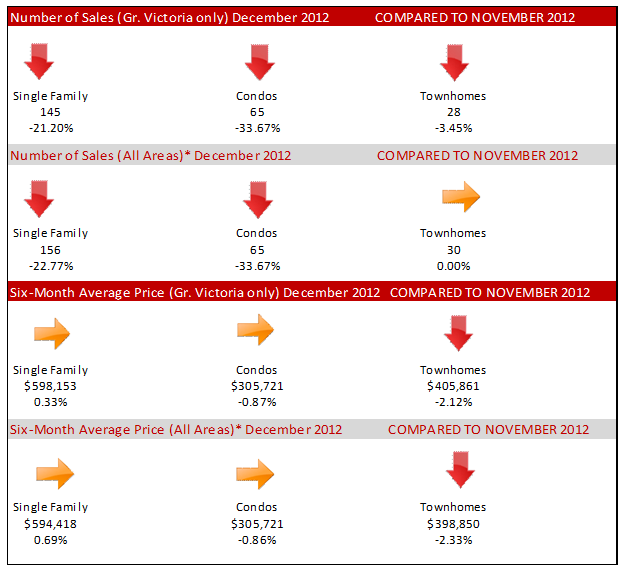
VICTORIA BC – Victoria’s real estate market ended 2012 with relatively flat pricing when compared to 2011, along with similar sales numbers for the third consecutive year.

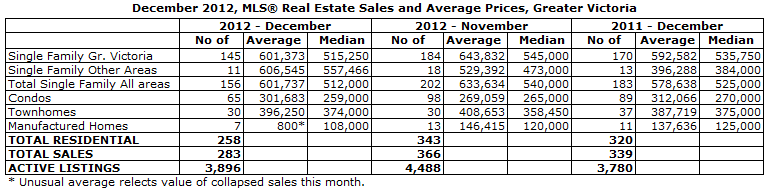
Total MLS® sales in December 2012 were 283, a 17% decrease over December 2011 when 339 units sold. A different picture is told, however, when comparing full years, where there is only a 5% decline from 2011 to 2012.

Similarly, pricing has held steady year-over-year. The annual average price of a single-family home in Greater Victoria was $603,298 in 2012 compared to $613,839 in 2011. Shelley Mann, President of the Victoria Real Estate Board, notes that while the annual average in 2010 was $629,925, it was $580,748 in 2009.

“In December there were less active listings on the MLS® system than in recent months,” Mann says. “With less competition, homeowners have a better opportunity to sell. But the property must show well, and they cannot expect to sell for the all-time high prices of 2010 and 2011.” Current active listings are 3,896.

“We continue to see buyers waiting to make their move. Two factors seem to have triggered this, the first being the tightening of lending regulations which has affected the purchasing power of many consumers,” Mann says.

“The second factor is that some buyers are continuing to wait for the market to fall,” Mann says. “What we heard at the local 2012 CMHC Housing Outlook Conference is that the market has bottomed out and slow growth is in store for 2013.”

There were 65 condominium sales in December 2012, compared to 98 in November 2012 and 89 in December 2011, and the year-over-year average price has decreased by 3%. Townhome pricing remains flat.

Total Waterfront Single Family Dwellings sold: 10, also 10 in December 2011 Total Non-waterfront Single Family Dwellings sold: 146, down 27 sales from December 2011 Single Family Dwellings sold over $1 million: 10 (3 over $2 million)

Total Single Family All Areas includes Shawnigan Lake/Malahat, Gulf Islands and Up Island

Summary Report and Graphs

Monthly Sales Summary

Average Selling Price Graphs

Active Listings, New Listings and Sales Graphs

Victoria Real Estate Sales Slow but Steady in Buyers’ Market

VICTORIA BC – While the number of single-family home sales has held relatively steady over the last three months, Greater Victoria REALTORS® are noting a year-over-year decrease that coincided with tighter mortgage regulations imposed in July of this year. Amortization periods were reduced to 25 years for high-ratio buyers – those with less than 20% down payments.

“The change from a 30- to 25-year amortization can result in an additional $150 to $200 on the monthly mortgage payment, which is impacting many first-time homebuyers and limiting the number entering the market,” says Carol Crabb, President of the Victoria Real Estate Board.

Crabb also notes that the median price for a single-family home in Victoria remains relatively flat, increasing 1% over November 2011. “Sales may have slowed, but the median price of single-family homes has not decreased. Condominiums, the primary option for those first-time buyers, have a decreased median price of 10%.”

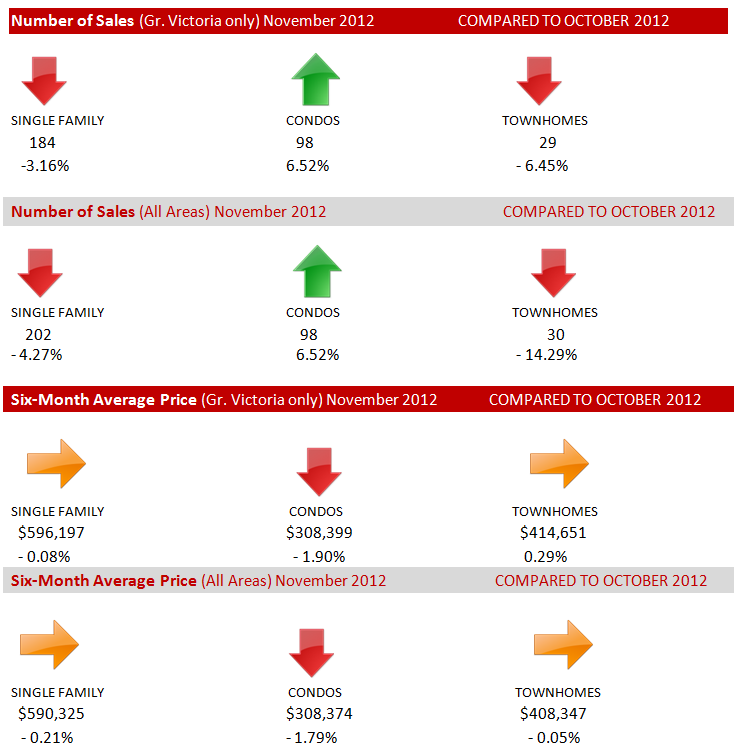
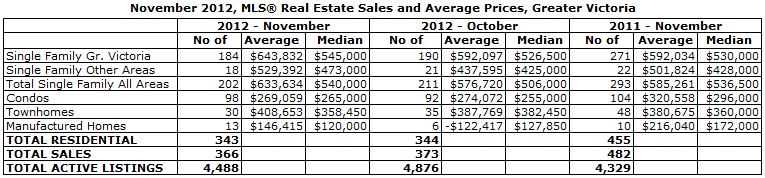
Total MLS® sales for November 2012 were 366 compared to 373 the previous month; 202 single-family homes sold throughout the Victoria Real Estate Board’s region, compared to 293 in November 2011. The median price for single family homes was $540,000, up 1% from last November’s median of $536,500. The average price for the same period is up $48,373 (8%), but this is influenced by two sales over $2 million and one sale over $5 million. Month-over-month, the six-month average for single-family homes is flat.

“We are now moving into the slower winter season. Both Canada Mortgage and Housing (CMHC) and Cameron Muir, Chief Economist of BC Real Estate Association, predict the next few months will mirror October and November, followed by slow growth for the balance of 2013,” Crabb says. BC and Greater Victoria continue to experience strong full-time employment growth, an expanding population and low mortgage rates.

“For buyers, there is a good supply of homes on the market, so while they have time to conduct due diligence they shouldn’t expect large reductions on all properties. We are still seeing quick sales and the occasional bidding war on homes that are priced well.

“Sellers have a lot of competition, so curb appeal, how the house shows and competitive pricing are key to moving from ‘For Sale’ to ‘Sold’,” Crabb says.

Condominium sales remain stable with 98 in November 2012, compared to 92 in October 2012 and 104 in November 2011, although the year-over-year median price has declined 10%. Townhome sales declined 38% in 12 months, while pricing remains flat.

Total Waterfront Single Family Dwellings sold: 6, down 4 from November 2011 Total Non-waterfront Single Family Dwellings sold: 196, down 97 sales from November 2011 Single Family Dwellings sold over $1 million: 17 (2 over $2 million, 1 over $5 million)

Summary Report and Graphs

Monthly Sales Summary

Average Selling Price Graphs

Active Listings, New Listings and Sales Graphs


Selkirk Waterfront: From Mill to Modern Community

Two decades after the Jawl family bought a 25-acre former sawmill site on Gorge Road, the final project is going up on the Selkirk Waterfront.

Heavy equipment is preparing the last piece of the mill site for a six-storey, $17-million building that will be ready for B.C. Investment Management Corp. in 2015, said Robert Jawl of Jawl Properties. Already based at Selkirk, the agency will consolidate operations in the building, which is designed by D’Ambrosio Architecture and Urbanism.

The building will have 51,000 square feet of offices on its upper four floors, 3,000 square feet of retail-commercial and eight higher-end condominiums facing the water, Jawl said.

Walkways on two office levels will link it with the adjacent building, where B.C. Investment Management staff already work.

Heavy industry was once the norm around Victoria’s waterways. But tough times in the forest industry saw the mill – owned by B.C. Forest Products and later Fletcher Challenge – close in the summer of 1989.

The City of Victoria wanted something special on the high-profile property and discouraged a warehouse proposal from Price Club. The Jawls purchased the land in 1991 and set out with a seven-year plan that stretched nearly three times longer. “We bought the property because … we thought it had potential for improvement,” Mohan Jawl said. Jawl worked at the mill in high school. He worked nights in the planer mill hauling wood with his three brothers with little idea at the time he would help to reinvent the property. “We didn’t know exactly what sort of development would be appropriate for the site or what sort of development would be approved.”

The Jawls worked with a trio of young architects – Peter de Hoog, Christopher Rowe and Franc D’Ambrosio (who still is based at Selkirk) – as well as the Burnside Gorge Community Association, various engineers and the City of Victoria. Together, they crafted an award-winning development that set an example on how to create a place to work and play, with housing, parks and commercial space. The last project will bring to 20 the number of buildings on the site. “In terms of architecture and design, [Selkirk Waterfront] has really been first-rate,” said Victoria Coun. Pamela Madoff. Its development plan was called “new urbanism,” she said, noting the three architects “put their hearts and souls into it.” The Jawls “do what they say they are going to do,” Madoff said. “Obviously it’s a business, but I think they really understand and support community.”

This site brought a new challenge to its owners. “It was a leap for us in that the type of development was something we had not done before,” Jawl said. Ground-breaking features such as brick paving and traffic circles all needed city approval, he said. “They showed a lot of confidence in us and we felt a lot of responsibly as a consequence.” “It turned out to be something very close to what we had hoped to do on the site,” Jawl said. “That really is a sign of a community when you have so many different uses coming together and working reasonably well.”

Most buildings are owned by the developer, other than one office complex and condos, always intended to be sold. “One of the commitments we made was not only to undertake the development but to see it through,” Jawl said. Selkirk’s build-out took longer than the seven years originally expected. “It’s a lesson we learned during the course of that project, that time lines are very tenuous and really are driven by market conditions,” Jawl said.

Today the site again plays an important economic role. A conservative estimate puts 2,000 office and retail workers at Selkirk, said Robert Jawl. Restaurants, a chiropractor, salon, gym, rowing club and festivals are part of its makeup. Maple trees with bright orange, red and gold leaves are planted throughout. Viewpoint stations, a boardwalk, public art and benches invite visitors. Linette Abbot walks SPCA dogs through the property, linked to the Selkirk Trestle and the Galloping Goose. “I love the bird life, especially this time of year. There are a lot of migratory birds,” she said this week.

Among its contemporary style buildings and infrastructure, physical reminders of the lumber business remain in old machinery now used as art. During recess this week, Grade 1 and 2 students raced happily into one of its parks to climb on huge concrete forms once used for loading.

A PROUD PAST

Originally published by Carla Wilson, Times-Colonist, November 3, 2012