Skip to Content

Victoria Real Estate Market continues 2014’s upward trend

untitledThe Victoria Real Estate Board today released its report on real estate activity in the Victoria area for January 2015.

351 properties sold in the Victoria region this January, an increase of 2.6% when compared to the 342 properties sold in the same month last year.

“We don’t expect to see big numbers in January. It’s a slower month traditionally for real estate,” Victoria Real Estate Board President Guy Crozier says. “Even this slight increase after the 11.67% year over year increase in sales we saw in 2014 shows the continued stability of our market. There’s also a good balance of inventory available for sale, which will likely appeal to buyers as the spring season hits. Last month while we saw 10 single family homes sold for over a million dollars, there were also 95 homes sold for under $500,000.”

At the end of January there were 3,283 active listings for sale on the Multiple Listing Service®, a slight decrease from the 3,489 in January 2014. This continues a trend that started in mid-2013 where there are fewer listings in the market than there were in the same month of the year previous.

The Multiple Listing Service® Home Price Index benchmark value for a single family home in the Victoria Core this time last year was $548,500. The benchmark value for the same home this month has increased by 2.39% to $561,600.

“With the change in mortgage rates surprising some, and the continuing low oil prices and Canadian dollar, the spring real estate market should be an interesting one to watch,” Crozier adds.

The complete statistics package can be found here and will be posted this afternoon on VREB.org.


Should I Buy a House Now or Wait?

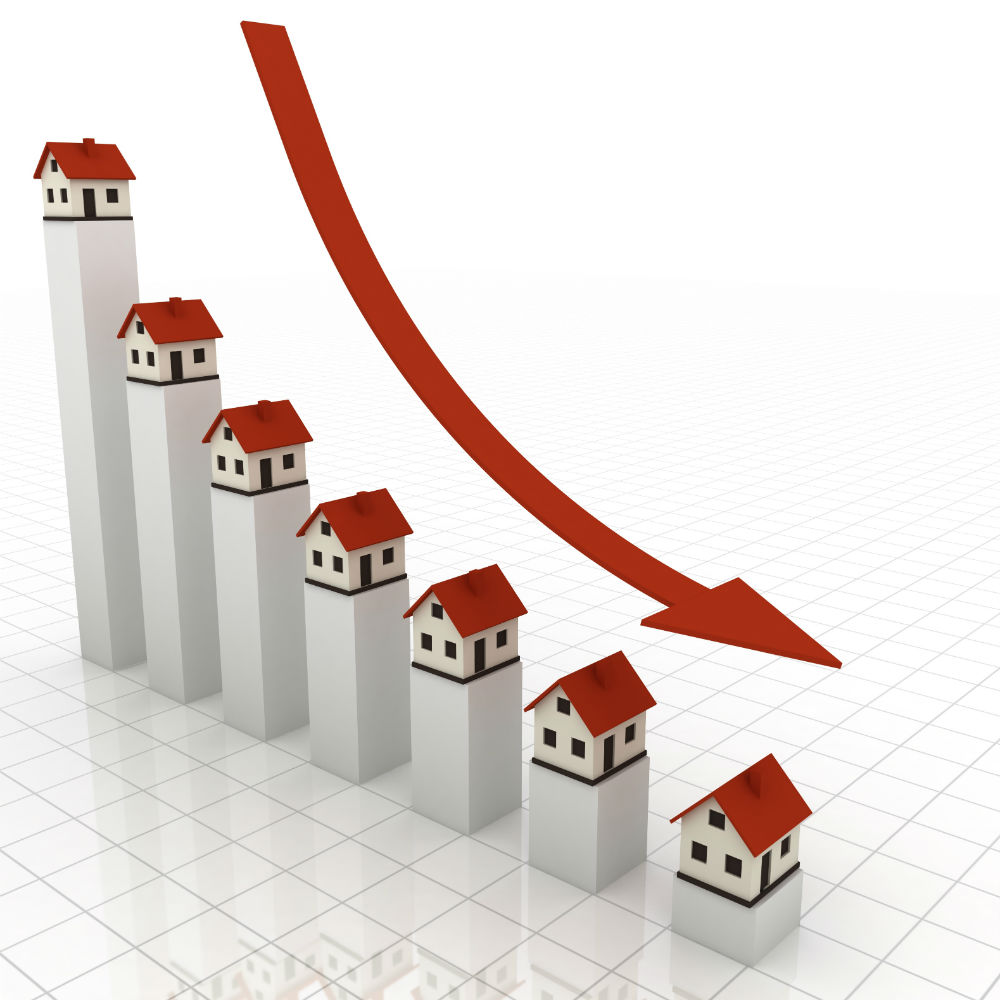
HouseChartDown-AlexSlobokin-1000In the market for a new home this year? Then you must be quaking in your snow boots after the news agencies reported the recent catastrophic predictions of Duetsche Bank.

According to the international Bank’s chief international economist, Torsten Slok, Canadian homes are 63% overvalued—the single largest prediction of doom for this country’s housing market. The Duetsche Bank predictions came supported with charts and statements that show Canada’s housing market is valued 35% higher than the median house price (when compared to median household income) and 91% when compared to average rental rates. As a potential home buyer, I won’t blame you if all you want to do is stick your head in the sand (on some sunny, non-Canadian beach somewhere) and hide. But don’t. And, as trite as it sounds, please don’t worry. Despite the latest grand predictions, the housing market in Canada really isn’t going to crash. Now, I’m not an economist. I don’t spend my days or nights analyzing reams of data and finding patterns or anomalies in numbers. I am, however, a journalist, and I’ve spent the last few months talking to analysts and economists from across Canada about the possibility of a housing market crash in Canada. These experts have stated that, despite what catchy headlines predict, a crash just isn’t likely. And they’ve stayed up nights analyzing reams of data and finding patterns and anomalies in numbers.

Why there won’t be a housing market crash in Canada

“We’re expecting a soft landing for Canada’s housing market in 2015,” explains Marc Pinsonneault, senior economist at National Bank of Canada. “There won’t be a profound correction in housing prices.”

While Pinsonneault and his colleagues do believe house prices will decline in 2015 and 2016, they’re convinced it will be s slow cooling, not a crash. (Cooling is a term used to describe a housing market that slowly depreciates in terms of price and number of sales. A cooling market means there is no sudden, large drop in prices, sales or new builds, which are indicators of a market crash.) The first reason Pinsonneault predicts a cooling and not a crash is that mortgage rates aren’t going to escalate rapidly over 2015 and into 2016. “We’re going to see increases, but not 100 basis points at a time,” says Pinsonneault. Pinsonneault is also convinced there won’t be a crash because demand really is keeping up with supply. According to his research, building starts and absorption rates—the number of newly built condos and homes that were actually sold—are on par with historical averages. “The ratio is not far off the long-term average of 1.03,” he says. This means the claims of overbuilding—which further fuel this idea of a housing market crash—are unfounded in cities like Toronto, Calgary and, potentially, Vancouver. Senior economist with Capital Economics, David Madani, is critical of this analysis. He’s also seen the numbers and concedes that supply really does appear to be keeping up with demand—at least from a statistical perspective—but he cautions there still could be problems. “There are too many one-bedroom condo units being built when demand shows a need for family accomodation,” says Madani. It’s a concern that was highlighted in the Duetsche Bank report; they reported that building starts for detached, single family homes was stagnant over the last decade, while building starts for condos and townhomes had increased dramatically over the last 10 years. But Pinsonneault believes these numbers just support the growing notion that land, and scarcity of this limited commodity particularly in downtown, urban centres, is what is pushing up housing prices, not over-valuation.

Don’t time the market

So what’s a regular home buyer to do? If you’re ready to jump in and buy, and you can afford a house in your local market, then do it. Don’t wait for house prices to fall.

“Timing the market is never wise,” explains Ted Rechtshaffen, president and CEO of TriDelta Financial. He explains that when buying a home, “it’s not about the home price, but the mortgage rate.” If you can afford to pay the mortgage now—and you can still afford to pay the mortgage five years from now after rates have risen, then you can afford to buy. For today’s home buyer that means calculating whether or not you can afford monthly payments for your dream home at rates of 4% or 5%.

Prepare for a drop in value

It also means deciding whether or not you can stomach a drop in home values. Even if the housing market doesn’t crash and lose 60% value, most economists are predicting some sort of cooling in the nation’s housing market. Predictions range from 10% to 30%, with the top-end of the correction occurring in the country’s hottest markets, such as Vancouver.

To put this in perspective: on a $450,000 home a 10% drop in value is a loss of $90,000. It would take a decade for you to recover that lost value (assuming your home appreciated at the historic norm of 2% in value per year).

Put down the biggest down payment you can afford

Calculating whether or not you can afford a home and stomach a price drop is even more important if you’re putting down less than 20% as a down payment. If you only put 5% down on a $450,000 home and prices dropped by 20%, your home would be worth less than the amount you owed on the bank—and this could spell trouble when it came time to renew your mortgage. The key is make sure you put a large enough down payment into the home to ensure that you’ve got equity in the property, even if prices do drop. The reason? You need to own more than you owe in order to qualify for a mortgage.

Fixed is the way to go for mortgages

If you decided to take the plunge, ignore the doomsayers, and buy a home in one of Canada’s real estate markets then the decision you’ll be faced with is whether to choose a fixed or variable-rate mortgage.

In the past, those who opted for variable ended up paying less. But these days the difference between fixed and variable is so small it’s not worth the uncertainty, says Rechtshaffen. “Don’t get greedy. Just take the fixed-rate mortgage that’s under 3% and be thrilled.”

 

by Romana King

Will real estate sales in Victoria continue the upward trend into 2015?

images6DYMYRRCThe Victoria Real Estate Board today released its report on real estate activity in the Victoria area for December 2014.


389 properties sold in the Victoria region this December, an increase of 9.6% when compared to the 355 properties sold in December last year. Overall, 2014 saw 11.67% more sales than in 2013.


“I think the increase in sales we saw in 2014 surpassed a lot of people’s expectations. To see growth of over 10% – that shows consumer confidence and interest in our market,” Victoria Real Estate Board President Guy Crozier says. “Of course one factor that helped sell houses this year was the low mortgage rate. That, combined with balanced market conditions, created a steady, consumer-friendly environment in which to purchase and sell properties.”


The Multiple Listing Service® Home Price Index benchmark value for a single family home in the Victoria Core this time last year was $542,800. This month the benchmark value rose 2.9% to $558,500. Over the course of 2014, 6.2% of single family homes (238) sold for over one million dollars.


“There are two indicators to track in the New Year – the number of sales, and the amount of inventory currently available on the market. In 2014 we saw less inventory available than in previous years but more sales. With job growth predicted and consumer confidence increasing in our area, it will be interesting to watch these numbers as 2015 sales unfold.”

For Detailed Information and Statistics, please click here.

Steady Real Estate Market in Victoria Continues as 2014 Sales Surpass 2013 Numbers

vreb xmas The Victoria Real Estate Board today released its report on real estate activity in the Victoria area for November 2014.

465 properties sold in the Victoria region this November, an increase of 12.9% when compared to the 412 properties sold in November last year.

“This year has been great for Victoria real estate, we’ve seen a friendly market for buyers and sellers thanks to steady pricing and low mortgage rates,” Victoria Real Estate Board President Tim Ayres says. “By early last month sales in the Victoria area met the number of total sales we saw for the entire year of 2013, and now we are 5.18% over last year’s sales with another month to go before year end.”

The Multiple Listing Service® Home Price Index benchmark value for a single family home in the Victoria Core this time last year was $482,300. This month the benchmark value increased 1.4% to $489,000.

“Another statistic to watch is the number of active and new listings,” adds President Ayres. “682 properties were listed this November, and the total number of properties listed for sale including those newly listed was 3,631. That’s 9.6% fewer properties for sale than November last year.”

Victoria Real Estate Board President Tim Ayres is available for comment. More information on the November 2014 report and the Multiple Listing Service® Home Price Index is available from the Victoria Real Estate Board, vreb.org.

About VREB – Founded in 1921, the Victoria Real Estate Board is a key player in the development of standards and innovative programs that enhance the professionalism and community standing of REALTORS®. The Victoria Real Estate Board represents more than 1,200 local REALTORS®.

View our press release and summary here.

View our complete statistical package here.

Strong Victoria real estate market again in October

fall real estateNovember 3, 2014, Victoria BC – The Victoria Real Estate Board today released its report on real estate activity in the Victoria area for October 2014.


602 properties sold in the Victoria region this October, an increase of 17.6% when compared to the 512 properties sold in the same month last year.


“Here we are again, a month in 2014 ending with more sales than in 2013,” Victoria Real Estate Board President Tim Ayres says. “This year has been a solid year for local real estate – indeed we are only 154 transactions away from meeting the total number of sales from 2013 – and there are two more months left in the year!”


The Multiple Listing Service® Home Price Index benchmark value for a single family home in the Victoria Core this time last year was $547,800. This month the benchmark value increased to $553,900.


“All year we’ve seen a decrease in the number of active listings and increase in sales compared to 2013 numbers,” adds President Ayres. “Last year at the end of October we saw 4,322 active listings, and this year we see 3,927 active listings, that’s a 9.1% change.”  The complete statistics package can be found here and will be posted this afternoon on VREB.org.


Victoria Real Estate Board President Tim Ayres is available for comment. More information on the October 2014 report and the Multiple Listing Service® Home Price Index is available from the Victoria Real Estate Board.


About VREB – Founded in 1921, the Victoria Real Estate Board is a key player in the development of standards and innovative programs that enhance the professionalism and community standing of REALTORS®. The Victoria Real Estate Board represents more than 1,200 local REALTORS®.


Bank of Canada Interest Rate Decision – October 22, 2014

bank-of-montrealThe Bank of Canada once again chose to maintain it’s target for the overnight rate at 1 per cent this morning. In the statement accompanying the decision, the Bank noted that core inflation, which excludes volatile prices such as energy and food, has risen more rapidly than expected due to unexpected sector-specific factors while CPI inflation has evolved largely as expected.

While the Bank’s preferred measure of core inflation has trended above its 2 per cent target in recent  months, financial market volatility and fresh concerns over stagnant European economic growth provide some cover to maintain the status quo. Our forecast for the Canadian economy matches that of the Bank for economic growth to average 2.5 per cent for the second half of 2014 and for all of 2015. That rate of growth should eliminate much of the estimated slack in the Canadian economy by the middle of 2016. That forecast, and traditional lags in how monetary policy impacts inflation, suggests the Bank will embark on tightening monetary policy sometime toward the end of next year.

Strong Sales and Stable Market Conditions Continue Through September

October 1, 2014, Victoria BC – The Victoria Real Estate Board today released its report on real estate activity in the Victoria area for September 2014.

565 properties sold in the region this September – an increase of 16% compared to the 487 properties sold in the same month last year. The quarter ending in September shows a 15% increase in the number of sales overall compared to the same quarter in 2013.

“Once again we see more houses sold this month than last September,” Victoria Real Estate Board President Tim Ayres says. “We haven’t seen sales like this in September since 2009. The balanced market conditions we’ve seen over the last seven months mean property prices are stable, so it might be more comfortable for buyers and sellers to make a move because they know that property values are predictable.”

The Multiple Listing Service® Home Price Index benchmark value for a single family home in the Victoria Core this time last year was $550,900. This month the benchmark value increased to $556,200.

“There are some districts in the Victoria area that have seen an increase in their benchmark values, and others that are relatively flat compared to last year,” adds President Ayres. “Since there is this difference within the local market, it’s important to connect with your local REALTOR® to get an understanding of the market as it relates to your specific neighbourhood.”

View our press release and summary here:  http://vreb.org/pdf/VREBNewsReleaseAndSummary.pdf 


Surprising Summer Sales for Victoria and Area Real Estate

sand-castleThe Victoria Real Estate Board today released its monthly report on real estate activity in the Victoria area for July 2014.

681 properties sold in the region in the month of July 2014, compared to 583 last year in July – an increase of nearly 17%. June 2014 saw 680 sales.

When compared with year-to-date sales in 2013, 2014 shows a 10% increase.

“I think the activity in July has surprised a few people,” Victoria Real Estate Board President Tim Ayres says. “Traditionally the summer market is slower than the spring, but numbers are tracking closely to March and April sales this year. Last year sales in July were 12% lower than in June – and June was the peak of the market in 2013. This year we see slightly more sales in July than in June. This is the first year since 2003 that July numbers have beaten June.”

The MLS® Home Price Index (HPI) benchmark value for a single family home in the Victoria Core area in July was $562,000 – 2% higher than last year’s average value for the same home – $550,900.

“I’m looking forward to August numbers. With the diverse inventory on the market, stable pricing and the reasonable interest rates,” adds President Ayres, “I think the busy sales season could last into fall.”

Victoria Real Estate Board President Tim Ayres is available for comment. More information on the July 2014 report and the MLS® HPI is available from the Victoria Real Estate Board.

About VREB – Founded in 1921, the Victoria Real Estate Board is a key player in the development of standards and innovative programs intended to enhance the professionalism and community standing of REALTORS®. More than 1,200 local REALTORS® are currently members of the Victoria Real Estate Board.

View our press release and summary here.

View our complete statistical package here.

RBC Forecasts a Moderate Slow Down for Canada’s Housing Economy in 2015 – Steady As She Goes for Victoria’s Market

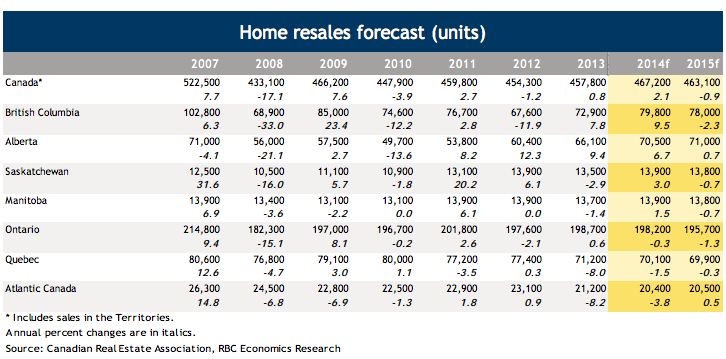
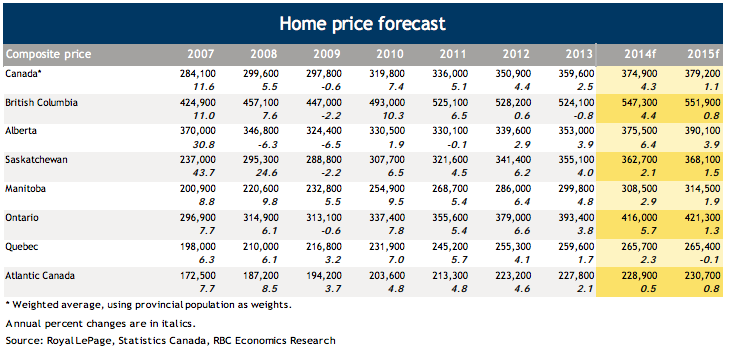
RBC 2015 Housing Forecast Screen-Shot-2014-08-21-at-10.02.40-AMCanada’s seemingly unstoppable surge in housing sales and price growth may slow down soon according to a new report from RBC Economics.

“Strained affordability” and rising interest rates are expected to cool down sales in the market in 2015 while prices will decrease substantially.

While resales will still see an increase of 2.1 per cent to 467,200 units in 2014, driven by the hot activity for the first part of the year and low mortgage rates, in 2015, the bank expects sales to decline by 0.9 per cent to 463,100. Price growth should moderate to a 1.1 per cent increase in 2015 after seeing a 4.3 per cent bump this year.

The reason? The low, low interest rates Canadians have been enjoying for years are unsustainable and longer term rates will begin to rise as the Bank of Canada tightens up conditions in 2015. Affordability in tight markets, plus rising interest rates, will make home ownership harder to reach, even if there’s continued growth in household income.

However, RBC doesn’t get too bleak about the state of the housing market, careful to call it a cooling and dispelling the idea that the country is headed for a crash. And some local markets will weather the changes better than others. Alberta and Atlantic Canada should escape the decline in sales seen in the rest of the country

For resales, British Columbia is expected to see the biggest drop of 2.3 per cent thanks in large part to high prices in Vancouver. Ontario follows with a 1.3 per cent slump predicted for 2015, thanks to the high-flying Toronto market.

Once again, Atlantic Canada will buck the trend with RBC predicting the East Coast will escape the marked slowdown in the rate of appreciation in 2015. Quebec should see a slight decline in prices next year due to a rise in supply, mostly fuelled by condos (in July, Montreal recorded its 47th month in a row for a year-over-year rise in active listings). Prices in BC and Ontario are also expected to be much more moderate and Alberta will still see price increases.

August continues to be hot and sunny – in the Victoria Real Estate Market too!

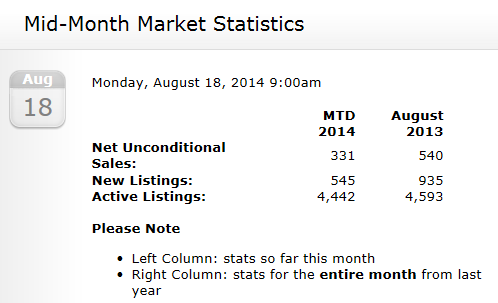
CaptureNumber of Sales is tracking to exceed August 2013, and inventory remains lower than this time last year, so definitely treading in balance market waters…….and no rain in sight to dampen the hot activity that continues with this sunny and warm summer in Victoria! Call me for more details about our current Victoria Real Estate Market.