Skip to Content

January Real Estate Market Starts on Solid Ground

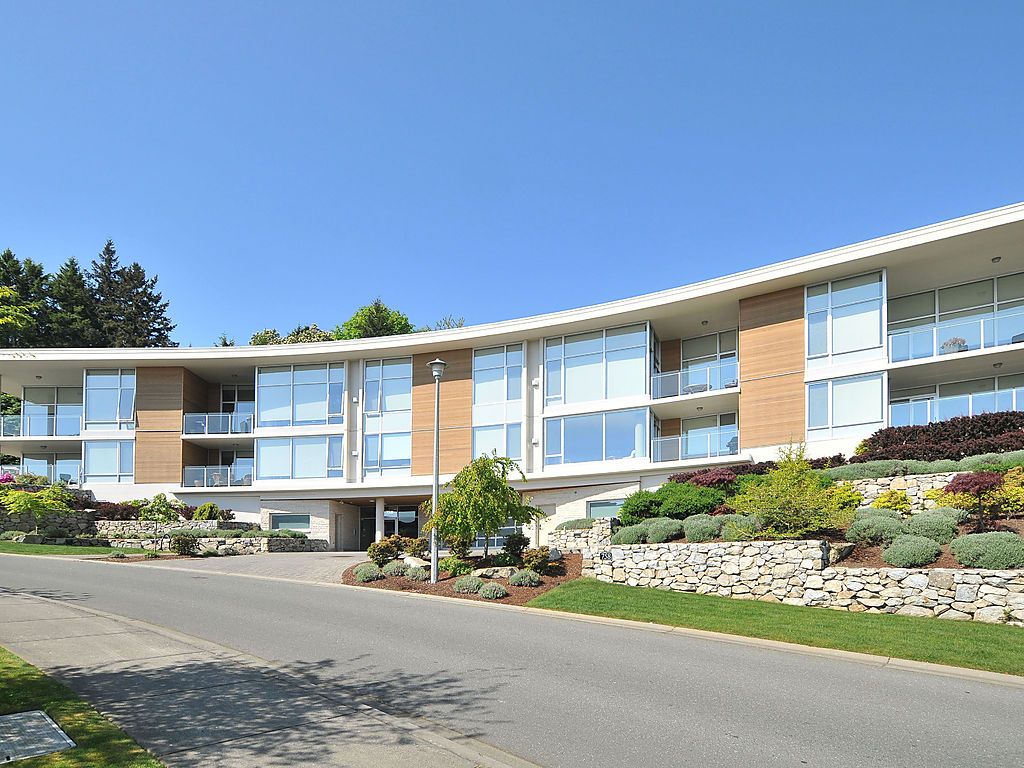
Victoria’s real estate market had a solid start in January, re-establishing momentum after the holiday season.SaywardHillRd758-203_30
Total MLS® sales in January were 342, a 16.3% increase over January 2013 when 294 units sold. January sales were close to the 355 sales reported to the Victoria Real Estate Board (VREB) in December 2013.

2014 VREB President, Tim Ayres cautioned, “While we’re pleased with the number of sales this January and the percentage increases over January 2013, it’s important to remember that the market last January was restrained under tightened mortgage amortization rules imposed in July 2012.”

The MLS® HPI single family home benchmark price for the entire Greater Victoria region was $481,200 in January, a 1.7% decrease when compared to the January 2013 value of $489,400.

“Market activity increased as the month progressed,” notes Ayres. “With REALTORS® reporting that attractively-priced and well-presented properties are moving quickly.”

At the regional level, the MLS® HPI benchmark price for the single family benchmark home in the Core municipalities was $546,300, an increase of 0.6% over the previous month and a 0.5% decrease over January 2013. In Westshore, the MLS® HPI benchmark price for the single family benchmark home was $404,800, virtually unchanged from December 2013 and a 1.5 per cent decrease compared with January 2013. The MLS® HPI benchmark price for the single family benchmark home on the Peninsula was $497,200 for January, a decrease of 0.5% over the previous month and a 4.9% decrease year-over-year.

There were 3,489 active listings at the end of January, a 10% decrease over January 2013. “Available inventory slowly declined for most of 2013,” says Ayres. “We will continue to monitor this trend and the impact on the market as 2014 unfolds.”

There were 92 condominium sales in January 2014, the same as December 2013 and 81 in January 2013. The region-wide MLS® HPI benchmark price in January for condos was $276,800, down 1.7% from $281,600 from one year ago.

For townhomes, 30 sold in January compared to 32 in December 2013 and 40 in January 2013. The region-wide MLS® HPI benchmark price for townhomes was $398,000, up 0.7% from $395,400 in January 2013.

Total waterfront single family homes sold in January: 7
Total non-waterfront single family homes sold in January: 186
Total single family homes sold over $1 million in January: 10 (1 over $3 Million)

At the heart of the MLS® HPI is the concept of the “benchmark” home, a notional home that has the most common features of a typical home in a given area. The benchmark home does not represent any actual house, condominium or townhome, but merely provides an identical example to track changes in market value. There are separate benchmark houses, condominiums and townhomes in each distinct area of Greater Victoria, enabling the tracking of values on a variety of geographic levels.

For more information on the MLS® HPI benchmark prices and index values, visit www.vreb.org. Those requiring specific information on property values in their area should contact a REALTOR®. The Victoria Real Estate Board has more than 1,225 Members working in more than 80 Brokerages.


View our complete statistical package here.

Helpful Moving Tips For You & Your Pet

Moving to a new home can be stressful on your pets, but there are many things you can do to make the process as painless as possibleroxy

  1. Update your pet’s tag. Make sure your pet is wearing a sturdy collar with an identification tag that is labeled with your current contact information. The tag should include your destination location, telephone number, and cell phone number so that you can be reached immediately during the move.
  2. Ask for veterinary records. If you’re moving far enough away that you’ll need a new vet, you should ask for a current copy of your pet’s vaccinations. You also can ask for your pet’s medical history to give to your new vet, although that can normally be faxed directly to the new medical-care provider upon request
  3. Keep medications and food on hand. Keep at least one week’s worth of food and medication with you in case of an emergency.
  4. Seclude your pet from chaos. Pets can feel vulnerable on moving day. Keep them in a safe, quiet, well-happy place. There are many light, collapsible travel crates on the market if you choose to buy one. However, make sure your pet is familiar with the new crate before moving day by gradually introducing him or her to the crate before the move.
  5. Prepare a first aid kit. First aid is not a substitute for emergency veterinary care, but being prepared and knowing basic first aid could save your pet’s life
  6. Play it safe in the car. It’s best to travel with your dog in a crate; second-best is to use a restraining harness. When it comes to cats, it’s always best for their safety and yours to use a well-ventilated carrier in the car.
  7. Find a new veterinary clinic and emergency hospital. Before you move, ask your vet to recommend a doctor in your new locale. Talk to other pet owners when visiting the new community, for veterinarians in your location.
  8. Prep your new home for pets. Pets may be frightened and confused in new surroundings. Upon your arrival at your new home, immediately set out all the familiar and necessary things your pet will need: food, water, medications, bed, litter box, toys, etc.
  9. Learn more about your new area. Once you find a new veterinarian, ask if there are any local health concerns such as heartworm or Lyme disease, or any vaccinations or medications your pet may require. Also, be aware of any unique laws. For example, there may restrictive breed laws in some municipalities.

Thanks to my sweet Roxy Chihuahua for the photo-shoot and inspiration for me to write this Blog!

2013 Real Estate Market Activity Expected to Carry into New Year

statistics-1aVICTORIA BC – Victoria’s real estate market ended 2013 with some momentum after a weak first quarter.

Total MLS® sales in December 2013 were 355, a 25% increase over December 2012 when 283 units sold. Annually, total units sold increased by 4%, with 5,998 in 2013 compared to 5,747 in 2012.

The overall MLS® HPI single-family home benchmark price for Greater Victoria was $479,500 in December 2013, compared to of $495,400 in December 2012, a decrease of 3.2%.

“Bear in mind that prices vary from area to area,” says Tim Ayres, 2014 President of the Victoria Real Estate Board. “I’m optimistic about the next year. Buyers who were on the sidelines are now out shopping. Savvy buyers need to know that there are some good deals in certain areas, and interest rates are not expected to increase in the near future.”

At the regional level, the MLS® HPI benchmark price for the single family benchmark home in the Core municipalities was $542,800, a decrease of 1.1 per cent over the previous month and a 2.4 per cent decrease over December 2012. In Westshore, the MLS® HPI benchmark price for the single family benchmark home was $404,200, an increase of 0.1 per cent over November 2013 and 3.6 per cent decrease over December 2012. The MLS® HPI benchmark price for the single family benchmark home on the Peninsula was $499,900 for December, a decrease of 1.6 per cent over the previous month and a 4.1 per cent decrease year-over-year.

There were 3,554 active listings at the end of December, a 9% decrease over December 2012, which Ayres notes contributes to stronger market conditions.

There were 92 condominium sales in December 2013, compared to 99 in November 2013 and 65 in December 2012. The overall MLS® HPI benchmark price of $278,600 was down 1.2% from December 2012. There were 32 townhome sales in December 2013, compared to 49 in November 2013 and 30 in December 2012. The overall MLS® HPI benchmark price of $392,500 was down 0.5% from December 2012.

Total Waterfront Single Family Dwellings sold: 10, also 10 in December 2012
Total Non-waterfront Single Family Dwellings sold: 178, down 32 sales from December 2012
Single Family Dwellings sold over $1 million: 13 (2 over $2 million)

At the heart of the MLS® HPI is the concept of the “benchmark” home, a notional home that has the most common features of a typical home in a given area. The benchmark home is not meant to represent any actual house, condo or townhouse, but merely provides an identical example to track market changes. There are separate benchmark houses, condos and townhouses in each distinct area of the Greater Victoria region, enabling price tracking of very distinct markets.

For more information on MLS®HPI benchmark prices and index values for November, visit www.vreb.org. Those requiring specific information on property values in their area should contact a REALTOR®. The Victoria Real Estate Board has 1,227 Members.

View our complete statistical package here.

ReMax Housing Market Outlook 2014 – Victoria, BC

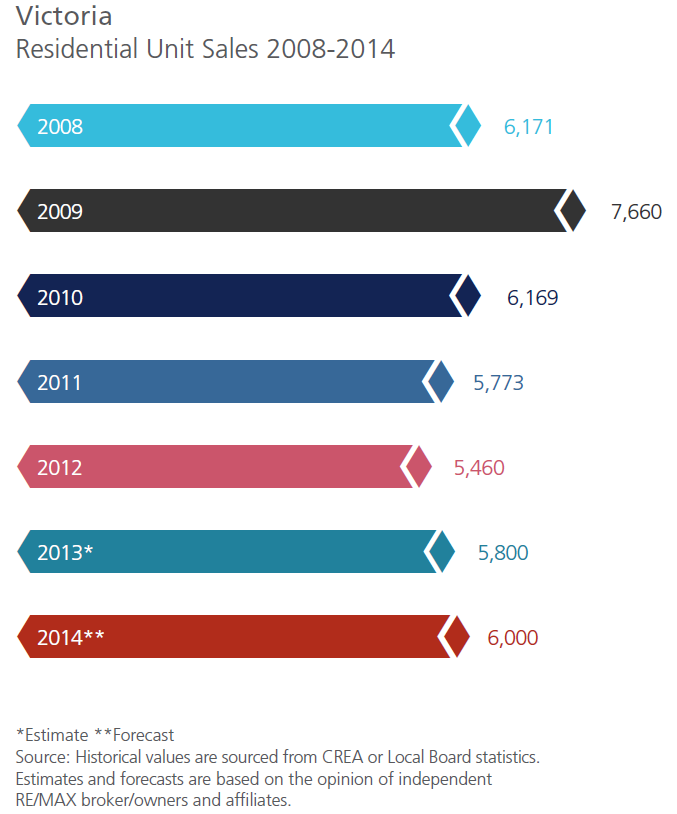
CaptureVictoria’s residential housing market marked a notable turnaround in 2013. Sales gained traction throughout the year, with a solid rally evident over the summer months. The upswing in momentum should see transactions surpass 2012 levels, as 5,800 homes change hands in the city by year end. Inventory has receded and conditions have largely stabilized, with the number of new listings becoming more consistent with traditional patterns. First-time and move-up buyers worked in unison to bolster demand virtually across the board. Purchasers, previously enticed by value south of the border, are returning in growing numbers, encouraged by opportunity in their own backyard. Average price remains level—expected to hold at $484,000 for yet another year— finally resuming a growth trajectory in 2014. In the interim, purchasers believe good value exists, as average price remains off peak. Activity is strongest at the entry-level price point in each segment. At the lower end, newer, reasonably-priced condominium units, offered under $300,000, are moving well, while on the move-up side, single-family homes priced under $500,000 are garnering attention. The upper end of the market (over $1 million), where price adjustments continue to provide considerable impetus, posted double-digit growth this year. The greatest shift evident in 2013 was in consumer optimism, as confidence builds in Victoria and throughout the province.  Although government fiscal restraint and reduced capital investments limited economic performance in 2013—GDP growth in the province demonstrated a weak 1.5 per cent gain—some improvement is on tap heading into the new year. The city of Victoria is expected to benefit from strengthening recovery in the U.S., which should serve to bolster trade and tourism. An improving jobs picture will support housing demand, along with the continuation of low interest rates. Activity in the  construction industry should edge higher, as the number of housing starts climbs modestly.

GDP growth in the province overall is expected to nearly double from year-ago levels, moving forward by 2.7 per cent in 2014, as British Columbia’s natural resource sector regains renewed momentum. Victoria’s enhanced outlook should result in a further upswing in residential unit sales in 2014, climbing four per cent to 6,000 units. Average price is expected to record a welcome gain of one per cent, rising to $490,000 by year end. Balanced conditions should characterize the market moving forward, although some slowing may emerge in the resale condominium segment, given the introduction of depreciation/deferred maintenance reports which will impact future condominium fees. As a result, newer buildings are expected to gain favour. One innovative project has generated surprising interest—a micro-loft offering in the downtown core [The Janion] —sporting 250 to 500 sq. ft. units, starting from $100,000. While affordability returns to the spotlight, with the return of rising prices, and unique solutions, sales at the top end are expected to inch up again— another sign that the market has regained some lustre.

Victoria Real Estate Sales Moderate in November; Overall Prices Remain Flat

info-statsGreater Victoria real estate sales moderated in November following a brisk June-to-October market. According to the Victoria Real Estate Board (VREB) MLS® System, 412 properties sold compared to 366 in November 2012, an increase of 12.6 per cent.

“We saw market activity slow down after a very busy five months,” says Shelley Mann, VREB President. “While sales were higher than in November 2012, fewer sales than previous months indicate a pull back in consumer demand.”

Flat employment and weak economic growth are likely contributors to a moderating market. Mann also notes that active listings continued to decline, with 4,017 at the end November compared to 4,488 in November 2012. December and January are typically the slowest months for real estate sales.

For November 2013, the MLS® HPI benchmark price for the Greater Victoria single family benchmark home was $482,300 and its corresponding index value was 136.5.  (This represents a 36.5 per cent increase since January 2005, when the index was 100). This benchmark price decreased 0.72 per cent over the past month and decreased 3.11 per cent over the last year.

At the regional level, the benchmark price for the single family benchmark home in the Core municipalities was $548,600, an increase of 0.14 per cent over the previous month and a 1.65 per cent decrease over November 2012. In Westshore, the benchmark price for the single family benchmark home was $403,600, a decrease of 1.70 per cent over October 2013 and 5.94 per cent decrease over November 2012. The benchmark price for the single family benchmark home on the Peninsula was $508,000 for November, a decrease of 0.04 per cent over the previous month and a 2.57 per cent decrease year-over-year.

There was a total of 381 single family homes sold in November, an increase of 11 per cent over November 2012. November also saw the reporting of 99 condominium sales and 49 townhouse sales in Greater Victoria. Benchmark prices for the Greater Victoria condominium benchmark home and for the Greater Victoria townhouse benchmark home for November were $280,600 and $389,000 respectively.

Total Waterfront Single Family Dwellings sold:                        9, up 3 over November 2012

Total Non-waterfront Single Family Dwellings sold:          207, up 11 over November 2012

Single Family Dwellings sold over $1 million:                            (1 over $2 million)

View our complete statistical package here

On November 1st, the VREB adopted the MLS® Home Price Index (MLS® HPI) to report residential property price trends. The methodology used by MLS® HPI has been endorsed by Statistics Canada, Canada Mortgage and Housing Corporation, the Bank of Canada, Finance Canada and Central 1 Credit Union.

At the heart of the MLS® HPI is the concept of the “benchmark” home, a notional home that has the most common features of a typical home in a given area. The benchmark home is not meant to represent any actual house, condo or townhouse, but merely provides an identical example to track market changes. There are separate benchmark houses, condos and townhouses in each distinct area of the Greater Victoria region, enabling price tracking of very distinct markets.

Canadian Third Quarter Real GDP Growth

canadian-economyThe Canadian economy grew 2.7 per cent at an annual rate in the third quarter, the fastest pace of growth in almost two years.  The economy was given a boost by an uptick in business investment which helped to offset a slight deceleration in household spending and a dip in exports. Moreover, while third quarter growth was strong, a significant portion of that growth came from accumulation of inventories and therefore we do not expect a repeat performance in the fourth quarter.

Although today’s GDP report was welcome news for the Canadian economy, It is unlikely to influence the Bank of Canada’s interest rate decision next week. It will take several quarters of similar growth and a concomitant rise in inflation before the Bank of Canada moves on interest rates, an outcome we do not see until 2015.

Where’s the fire? Here’s how Canada’s banks reacted to CREA’s October report

Canadian existing home sales fell 3.2 per cent month-over-month in October according to a report published on Friday by the Canadian Real Estate Association (CREA).bank-of-montreal

While this marked the first drop in resales since February 2013 and the largest monthly decline since the slowdown in summer 2012, sales still stood 8.3 per cent above 2012 levels.

Canada’s banks were quick to release briefings on the CREA report and, while each added its own slant, a consensus that a major housing correction was not in the cards emerged yet again.

“Looking past some of the wild swings (and the wilder headlines) seen in the past year, the broader trends in the Canadian housing market are surprisingly calm,” wrote BMO’s Chief Economist Douglas Porter. (Tweet this)

“With total sales basically flat versus a year ago so far in 2013 and almost every city sporting a modest, single digit price gain, we can only ask: Where’s the fire?”

Porter went on to comment that the moderation in national sales in October from the hot September numbers indicate underlying market conditions remain balanced.

Derek Holt and Dov Zigler, economists with Scotiabank, pointed out that while a single month of declining sales doesn’t make a trend, it does put “an end to the uninterrupted seven month string of sales gains since March.”

Holt and Zigler also wrote that the decline “would feed into our view that sales rose over the spring and summer at the expense of future months as people exercised options to purchase within 90-120 day mortgage rate commitments on fears of losing the juicy rate commitments back in the spring.”

The bottom line? The strong sales activity in spring and summer 2013 was a temporary interruption along a correcting sales path.

TD Economics’ Francis Fong shared Holt and Zigler’s view, as he wrote that “the resurgence in sales activity over the course of this year was likely driven by a frontloading of demand by borrowers with mortgage preapprovals jumping into the market to get ahead of the deterioration in affordability we have seen since May.”

Fong added that he is not anticipating a major housing correction and believes that several fundamental supports should continue to keep the market stable. (Tweet this)

Looking ahead to 2014, RBC Economics’ Robert Hogue wrote that Canadian resale activity will remain largely static overall. He also noted that demand will continue to be supported by positive employment trends, steady population growth and historically low levels of interest rates.

Hogue singled out condo construction in Canada’s largest markets as a source of concern, but was unconvinced that it would have a negative impact on Canadian housing.

“[T]he evidence to date suggests that these units are being mostly absorbed and, therefore, are unlikely to have a destabilizing effect,” he wrote. “We expect that the combination of flattening demand later next year and strong supply of newly completed condo units will rein in price increases in 2014.”

By: Sean MacKay November 18, 2013

BuzzBuzz Home – Western Report


Strong October Kicks off Fourth Quarter Real Estate Sales in Greater Victoria

Greater Victoria continued to experience strong home sales during the month of October, reports the Victoria Real Estate Board (VREB). According to the Board’s MLS® System, 512 properties sold compared to 373 in October 2012, an increase of 37.27 per cent. There were 4,322 active listings.
“While we are all very pleased with the October results, we are tempering our enthusiasm,” says Shelley Mann, Board President. “After a slow market for the last half of 2012, we are still climbing back to previous annual sales numbers.”
Today, the VREB and joins the Canadian Real Estate Association and ten major real estate markets in Canada by adopting a new approach to the reporting of trends in residential property prices. Instead of relying on average and median sale prices which are subject to fluctuation, the Board moved to a new system called the MLS® Home Price Index (MLS® HPI). The methodology used by MLS® HPI has been endorsed by Statistics Canada, Canada Mortgage and Housing Corporation, the Bank of Canada, Finance Canada and Central 1 Credit Union.
At the heart of the MLS® HPI is the concept of the “benchmark” home, a notional home comprising the most common attributes of typical homes in a given area. Through the analysis of ten years of VREB MLS® sales data, MLS® HPI has defined benchmark homes for Greater Victoria as a whole as well as for each of our regions, districts and neighbourhoods. In each of these areas, MLS® HPI has defined a benchmark home for each category: single family homes, townhouses and condo apartments. Each month, VREB MLS® sales data will be fed into the MLS® HPI to calculate and track changes in the prices of our benchmark homes.
Benchmark prices are generally lower than corresponding medians and averages. MLS® HPI estimates the values of our typical homes, whereas medians and averages merely reflect the overall selling prices of the particular mix of homes that sold in a given month.
In a manner similar to the Consumer Price Index (CPI), MLS® HPI maintains a running index of the percentage change in benchmark prices. Like the CPI, the MLS® HPI assigns an index value of 100 to the benchmark prices at its starting point: January 2005. By tracking both benchmark prices and index values each month, MLS® HPI will provide a much clearer picture of real estate market trends in Greater Victoria.
“Past reporting of averages and medians showed flat pricing across the Board’s trading area but MLS® HPI indicates a moderate decline in prices in many markets over the last year,” Mann says. “Benchmark prices are flat month-over-month, and we will be watching very carefully to see where pricing goes.
“With average and median prices, it was often difficult to gauge whether prices of typical homes were rising or falling, but the HPI provides us with exactly this type of information,” she says.
For October 2013, the benchmark price for the Greater Victoria single family benchmark home was $485,400 and its corresponding MLS® HPI index value was 137.2. (This represents a 37.2 per cent increase since January 2005, when the index was 100). This benchmark price increased 0.15 per cent over the past month and decreased 3.18 per cent over the last year.
At the regional level, the benchmark price for the single family benchmark home in the Core municipalities was $547,800, a decrease of 0.56 per cent over the previous month and a 2.66 per cent decrease over October 2012. In Westshore, the benchmark price for the single family benchmark home was $410,600, a decrease of 0.37 per cent over September 2013 and 4.37 per cent decrease over October 2012. The benchmark price for the single family benchmark home on the Peninsula was $508,700 for September, an increase of 1.22 per cent over the previous month and a 3.56 per cent decrease year-over-year.
There were a total of 274 single family homes sold in September, an increase of 29 per cent over September 2012. September also saw the reporting of 126 condominium sales and 51 townhouse sales in Greater Victoria. Benchmark prices for the Greater Victoria condominium benchmark home and for the Greater Victoria townhouse benchmark home for September $283,100 and $393,100 respectively.
Total Waterfront Single Family Dwellings sold: 17, up 2 over October 2012
Total Non-waterfront Single Family Dwellings sold: 257, up 62 over October 2012
Single Family Dwellings sold over $1 million: 16 (1 over $2 million)
For more information on MLS®HPI benchmark prices and index values for September, visit www.vreb.org. Those requiring specific information on property values in their area should contact a REALTOR®. The Victoria Real Estate Board has 1,224 Members.

Property sales and price forecasts for 2013 and 2014 in Canada updated

525-Towner-Park-RoadNational residential property sales in Canada have improved more quickly than anticipated and as a result the Canadian Real Estate Association has updated its forecasts for 2013.

Sales are forecast to reach 449,900 units in 2013 and the national average home price is projected to rise by 3.6% to $376,300 in 2013.

The sales forecast represents a fall of 1% from last year and marks the sixth consecutive year for which activity will have held to within short reach of 450,000 units. CREA’s previous forecast for national sales in 2014 remains little changed.

The upward revision to activity in British Columbia accounts for nearly half of the small upward revision to national activity this year. The forecast for sales across the Prairies has also been raised. British Columbia and Alberta are the only provinces where CREA annual sales are forecast to rise above levels last year.

In 2014, national activity is forecast to reach to 465,600 units, a rebound of 3.5% and in line with its 10 year average. CREA said that the forecast increase reflects a gradual strengthening of sales activity alongside further economic, job, and income growth combined with only slightly higher mortgage interest rates.

British Columbia is still forecast to post the strongest sales increase in 2014 with an increase of 6.7% compared to a weak result in 2013. Most other provinces are forecast to post gains in the range between 2% and 4%.

Average prices have also remained firmer than expected due to a rise in the share of national sales among larger and pricier markets compared to last year.

The national average home price is projected to rise by 3.6% to $376,300 in 2013, with gains strongest and in the range between 4% and 5% in Prairie provinces and around 6% in Newfoundland and Labrador. Average price growth in British Columbia and Ontario is expected to come in just under the national increase, advance by less than 1% in Quebec and New Brunswick, and recede by less than 1% cent in Nova Scotia.

‘The environment for home prices in Quebec, New Brunswick, and Nova Scotia will likely be shaped by ample inventory levels relative to sales,’ said Gregory Klump, CREA’s chief economist.

‘The balance between the two indicates that buyers have an abundance of listings from which to choose in those provinces, which could keep pricing prospects in check until sales draw down inventories,’ he added.

The national average price is forecast to edge up a further 1.7% in 2014 to $382,800. Alberta is forecast to see the biggest average price increase in 2014 of 3.4%, with gains in Saskatchewan, Manitoba, and Newfoundland and Labrador running just ahead of overall consumer price inflation. Average prices in Quebec and New Brunswick are expected to remain stable in 2014, with other provinces eking out gains ranging from 0.5% to 1.5%.

logo

Home Sales Bolstered by Proper Pricing in Greater Victoria

statsVICTORIA, BC–Finishing up the strongest third quarter since 2009, the Victoria Real Estate Board reports that properly priced homes are selling which, along with reduced inventory levels, contributed to favourable market conditions. Q3 sales totalled 1,610, a year-over-year increase of nearly 15 per cent.

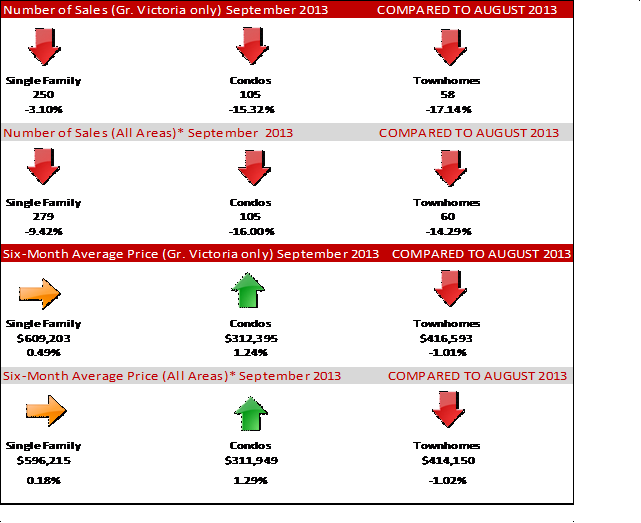
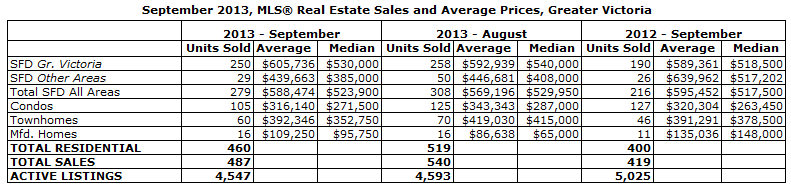
On a monthly scale, total real estate sales in Greater Victoria were up 16 per cent in September 2013 over September 2012. A total of 487 properties sold last month, finishing off a strong third quarter. Residential sales increased by 15 per cent year-over-year, while active listings decreased by 9.5 per cent year-over-year to 4,547.

“Last year at this time, sales volumes were being undermined by the amortization changes,” says Shelley Mann, Board President. “This year is following a more historic pattern. Properly priced homes are selling and as a result consumers are responding.”

Mann adds that while sales increased over the last four months, prices remained flat. “We don’t expect any significant price increases in the near future,” she says. “Our provincial economist noted that while unit sales are recovering, the weak economy bears watching.”

There were 279 single family homes sold in September, an increase of 29 per cent over September 2012, while the median price of $523,900 is up just over one per cent year over year from $517,500. There were 105 condominium sales with a median price of $271,500 and 60 townhomes sold at a median price of $352,750.

Total Waterfront Single Family Dwellings sold:                  19, up 1 over September 2012

Total Non-waterfront Single Family Dwellings sold:          260, up 62 over September 2012

Single Family Dwellings sold over $1 million:                      12 (1 over $4 million)

September 2013, MLS® Real Estate Sales, and Average and Median Prices, Greater Victoria

statisticalsummarySFD = Single-family Dwelling

Summary Report and Graphs

Monthly Sales Summary

Average Selling Price Graphs

Active Listings, New Listings and Sales Graphs

While the use of average price information can be useful in establishing trends when applied over a period of time, e.g. six months or longer, the Victoria Real Estate Board cautions that an average price does not indicate the actual value of a property in a particular neighbourhood. Those requiring specific information on property values in their area should contact a REALTOR®.