Skip to Content

Strongest Summer in Five Years for Victoria Real Estate Sales

Summer-time real estate sales numbers were the best they’ve been in Greater Victoria in five years. There was a total of 1,787 sales in June, July and August.

vreg aug 2012

On a monthly scale, total real estate sales in Greater Victoria were up 16.8 per cent in August 2013 over August 2012, the Victoria Real Estate Board reports. A total of 540 properties sold in August, finishing off a strong summer market.

“I’m very pleased with the August results. MLS® sales are strong and, with 4,593 active listings in all categories at month end, we remain on the cusp of a balanced market,” says Shelley Mann, President of the Victoria Real Estate Board.

The BC Real Estate Association defines a balanced market as when the ratio of sales to active listings is between 15 and 20 per cent. At month end, Victoria’s ratio for residential properties was 14 per cent.

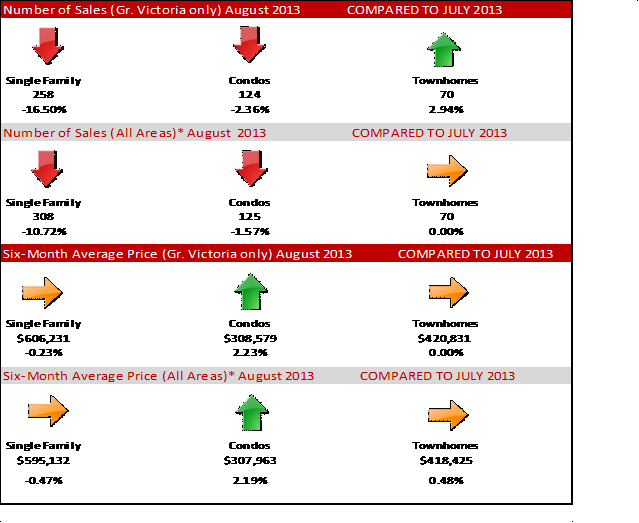
There were 308 single family homes sold in August, an increase of 28.3 per cent over August 2012, while the median price of $529,950 is up less than one per cent year over year from $526,250. There were 125 condominium sales with a median price of $287,000 and 70 townhomes sold at a median price of $415,000.

“Overall, pricing remains flat and our provincial economist predicts the trend will continue for another year. That said, the year-over-year median price of condos is up 9.2 per cent and the median of townhomes is up 12.5 percent,” Mann says. “This will vary between neighbourhoods, which is why I always recommend that consumers consult a REALTOR® for local pricing.

“With interest rates starting to increase, many buyers are locking into preapproved mortgages. These consumers should be purchasing in the next three to four months, so I believe the market will remain steady,” Mann says.

Total Waterfront Single Family Dwellings sold:                      20, up 7 over August 2012

Total Non-waterfront Single Family Dwellings sold:          288, up 61 over August 2012

Single Family Dwellings sold over $1 million:                         17 (2 over $2 million)


While the use of average price information can be useful in establishing trends when applied over a period of time, e.g. six months or longer, the Victoria Real Estate Board cautions that an average price does not indicate the actual value of a property in a particular neighbourhood. Those requiring specific information on property values in their area should contact a REALTOR®. The Victoria Real Estate Board has 1,222 Members.

August 2013, MLS® Real Estate Sales, and Average and Median Prices, Greater Victoria


2013 – August

2013 – July

2012 – August


No of Sales

Average Price $

Median Price $

No of Sales

Average Price $

Median Price $

No of Sales

Average Price $

Median Price $

SFD Gr. Victoria

258

592,939

540,000

309

596,445

529,500

215

590,843

530,000

SFD Other Areas

50

446,681

408,000

36

446,542

390,000

25

565,418

460,000

Total SFD All Areas

308

569,196

529,950

345

580,802

521,000

240

588,195

526,250

Condos

125

343,343

287,000

127

300,037

265,000

127

320,650

262,900

Townhomes

70

419,030

415,000

70

395,893

360,750

47

432,459

369,000

Mfd. Homes

16

86,638

65,000

17

203,765

118,750

16

131,069

106,450

TOTAL RESIDENTIAL

519


559


430


TOTAL SALES

540


583


462


ACTIVE LISTINGS

4,593


4,772


5,034


SFD = Single-family Dwelling

* All Areas includes Shawnigan Lake/Malahat, Gulf Islands and Up Island

Real Estate & Technologly: Digital House Hunt Study

APP AdA new collaborative report by Google and the National Association of Realtors (NAR) has uncovered some interesting trends and insights into the ways digital media is used in the home buying process.

One of the most eye-catching statistics included in the report is that 90 percent of American homebuyers used online resources while searching for a new home.

The data, collected by Google and the NAR through a variety of surveys conducted during 2011 and 2012, also pointed to some intriguing trends related to the digital realm’s effect on the home buying experience. Check out some highlights from the report below…

  • Real estate related Google searches have grown 253 percent over the past four years.
  • Shoppers will perform an average of 11 searches prior to taking action on a real estate site.
  • 69 percent of home shoppers who take action on a real estate brand website begin their research with a local term (eg. Houston homes for sale) on a search engine.
  • Mobile applications are used by 68 percent of new home shoppers at the onset and throughout their research.
  • Where do new home shoppers use their mobile devices? Here’s the breakdown: 77 percent at home, 31 percent at work, 28 percent when waiting in line, 27 percent at restaurant and 26 percent at other peoples’ homes.
  • YouTube is the top video research destination for home shoppers.
  • 78 percent of new home shoppers visit three or more sites prior to taking action on a real estate site.
  • 31 percent of home shoppers who take action on a real estate site are aged 25 to 34.
  • 52 percent of first time buyers started their search online.
  • 77 percent of first time buyers drove by a home viewed online.

I Love Technology! so much so, that I had my own personal real estate APP designed and it’s ready for download! Here is the Link to iTunes or just type in my name in iTunes Search. Download it for FREE today and let me know what you think!
https://itunes.apple.com/ca/app/ingrid-jarisz/id642703982?mt=8

Who cares about price?

Capture

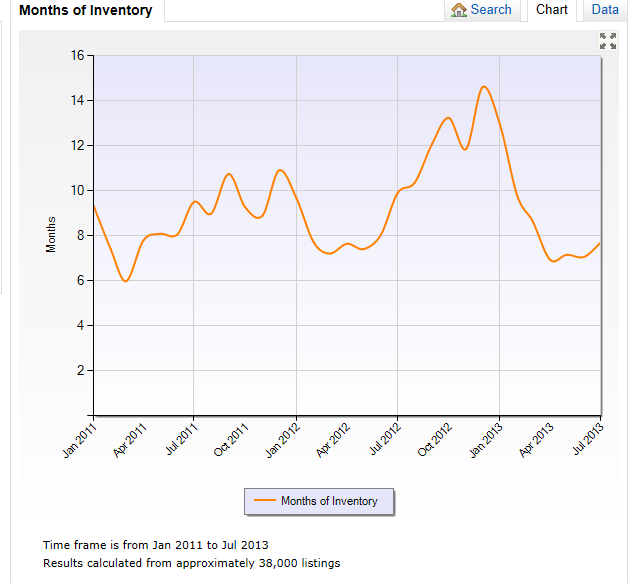
A REALTOR® once told me, “If you ever want to lose somebody at hello, just say ‘statistics.’” Maybe the same can be said for “economics” – but tuning out fundamental economic concepts like supply and demand turns a blind eye to forces that shape the price of everything. Most people pay attention to the bottom line if the price is big enough. The price of real estate certainly gets buyers’ and sellers’ attention, so the economics behind it matters. Advice from Greg Klump of the Canadian Real Estate Association.  [NOTE: See the Inset Graph from the Victoria Real Estate Board statistics showing a decline in months of inventory of current Greater Victoria Area properties for sale; Victoria was at a high of 14 months of inventory in January 2013 and today, we are now down to just above 7 months. ]

The bottom line for price is that it’s dictated by a meeting of minds between sellers and buyers. REALTORS® know that without that, there’s no deal. Who knew basic economics could be so simple and intuitive?

Of course, getting agreement on the price at which real estate can trade hands is rarely simple. That’s because psychology and expectations play such a major role. Many factors influence psychology and expectations, including the news media, family, and friends. Mindset affects both buyers and sellers, and can affect entire markets when a big enough group of buyers and/or sellers hold a similar mindset.

Predicting shifts in prevailing crowd psychology among buyers and sellers with any precision is difficult to say the least. However, the monthly trend for the number of months of inventory provides an important glimpse into the near future for price trends.

The number of months of inventory reflects how long it would take to completely liquidate inventories at the end of the month given current sales activity. The monthly trend for months of inventory is the thing to watch. If its trend drops to unusually low levels and stays there, demand is outstripping supply and big price increases should be expected. If its trend climbs to abnormally high levels and stays there, price stagnation and erosion is likely. The longer the trend persists, the more likely an outright price correction may occur.

In the absence of an economic shock, like an abrupt and lasting drop in employment, supply declines in response to lower demand. If supply falls quickly enough, an outright price correction is prevented. In the absence of financial distress or other motivation, sellers unwilling to accept offers too far below asking price either hold out awaiting “the right buyer” (i.e. one whose offer comes close enough to asking) or they take it off the market until demand improves. Whether the listing is taken off the market once it expires or languishes on the market unsold, supply effectively declines until there’s a shift in buyer and/or seller mindset when it comes to price.  That’s why real estate prices are, in the parlance of economists, “sticky downward” as sales activity recedes.

Few sellers are eager to accept offers well under what their neighbour sold for (presuming their homes are reasonably comparable). A major and sudden price correction requires more sellers to drop their asking price en masse than is typically the case in the absence of an economic cataclysm.

While the timing as to where in a housing market cycle one buys and sells matters, typical real estate market dynamics in a growing economy mean that prices don’t go down as much as they go up over the long term. REALTORS® know this. Everybody else should too.

CREA_GREG_95x95CREA’s Chief Economist, Greg Klump provides his views on the state of and outlook for Canadian housing markets to news media, policy makers, and real estate industry stakeholders. In 2012, Greg celebrated his 20th anniversary as a member of the team at CREA. He’s an avid skier and snowboarder during the winter and a year-round crossfit enthusiast.

Strong Sales Activity Continues in Greater Victoria Real Estate Market

August 1, 2013 – Total real estate sales in Greater Victoria were up 11.5% in July 2013 over July 2012, the Victoria Real Estate Board reports.”Sales numbers are slightly lower than in June, but that’s part of our normal summer market cycle. When seasonally adjusted, our market activity remains strong for this time of year,” says Shelley Mann, Board President.”Despite the brisk activity, we continue to see housing prices remain flat,” Mann says. “With fewer properties listed at the end of July, we are still narrowly into a balanced market.”With 583 sales in July and 4,772 active listings on the MLS® System at month end, the sales-to-active-listings ratio is 15%. Generally, analysts define a balanced market as when the ratio is between 15 and 20%.There were 345 single family homes sold in July, an increase of 17.7% over July 2012, while the median price of $521,000 is down 1.7% year over year from $530,000. There were 127 condominium sales with a median price of $265,000 and 70 townhomes sold at a median price of $360,750.”We are also seeing multiple offers on some properties,” Mann says, “although these offers are not always over the asking price, illustrating the importance of consulting a REALTOR® to gain individual neighbourhood insight.”Total Waterfront Single Family Dwellings sold: 18, up four over July 2012
Total Non-waterfront Single Family Dwellings sold: 327, up 48 over July 2012
Single Family Dwellings sold over $1 million: 19 (2 over $2 million)statisticalsummary

graphicalsummary

Summary Report and GraphsMonthly Sales Summary
Average Selling Price Graphs
Active Listings, New Listings and Sales Graphs


Living in Cordova Bay – Victoria’s Seaside Secret

Mattick's Green CondosLook who also loves living along Cordova Bay Golf Course! Mattick’s Green condominiums (in the background) were built by Jawl Development Corporation and offer 1,700 sqft of quality construction, 2 beds/2 baths, family room off kitchen and most with views of the golf course, Mt. Baker & Salish Sea. Residents also have added perks with discounts and advanced booking options at both golf courses, The Ridge Course at Cordova Bay, Bill Mattick’s Restaurant and just steps from Mattick’s Farm shopping too! Call me for more information on upcoming listings at 5327-5329 Cordova Bay Road – Mattick’s Green.

 
Mattick’s Green Condos

Who is buying Victoria’s Real Estate – June Stats from VREB


Every month, the Victoria Real Estate Board (VREB) tracks the activity of Buyer’s through a survey completed by Victoria area REALTORs®. Here are the June results for you info:

stats·         16% were first-time buyers

·         16% secured high-ratio mortgages, whereas 24% paid cash

·         14% were single females, 25% were couples with children and 14% were retired

·         61% were from within Greater Victoria, 6% from Up-Island, almost 10% from the Lower Mainland, and 8% from outside Canada

·         60% bought within Metro Victoria

·         Over 72% found the properties via a REALTOR® or the REALTOR’s® automatic search and less than two percent through print advertising.

For a Video Podcast of June’s real estate statistics, watch VREB President Shelley Mann report the monthly numbers: http://youtu.be/fZhKkmih0EE

Greater Victoria Real Estate Market Rebounds in 2nd Quarter

VICTORIA BC – For the third consecutive month, the Victoria Real Estate Board reports sales through the MLS® System remained strong with 65% more activity in the current quarter than in the first quarter of 2013.

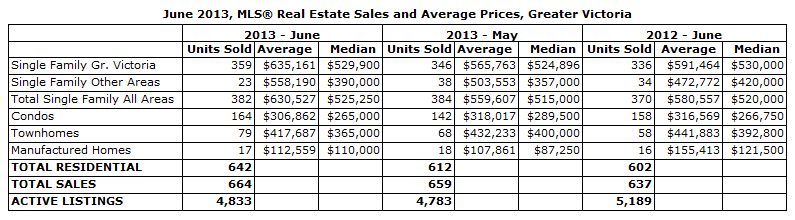
graphicalsummary“With 664 sales this month, and 1,938 sales this quarter, the market is definitely rebounding,” says President Shelley Mann. “We are now headed into the quieter summer months, so I’m interested to see where this leads.”

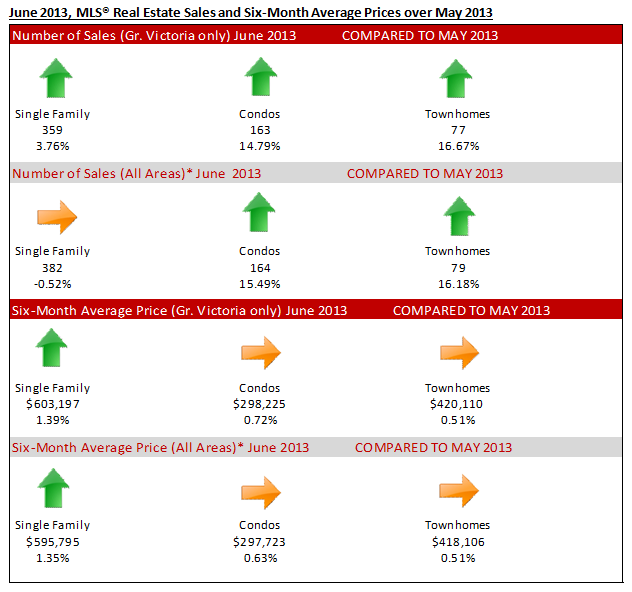
There were 382 single family homes sold in June at a median price of $525,250, up 1% over June 2012 at $520,000. Condominium sales were 164 at a median price of $265,000 and 79 townhomes sold at a median price of $365,000. There were 4,833 active listings on the MLS® System at the end of June, bringing the active-listings-to-sales ratio to 17%, well within the balanced market range.

“While sales are up, prices remain flat,” Mann says. “It is more important than ever to focus on the median prices. With six family home sales between $2 million and $7 million in June, the average price was pulled higher. The median price – the middle price – remained stable.”

Mann also advises buyers to consider long-term mortgages as she is hearing that long-term rates are starting to increase and lenders are providing fewer discounts on posted interest rates.

Total Waterfront Single Family Dwellings sold: 18, up two over June 2012
Total Non-waterfront Single Family Dwellings sold: 364, up 10 over June 2012
Single Family Dwellings sold over $1 million: 27 (6 over $2 million)

Stats Quick Referencestatisticalsummary

Total Single Family All Areas includes Shawnigan Lake/Malahat, Gulf Islands and Up Island

Summary Report and Graphs

Monthly Sales Summary
Average Selling Price Graphs
Active Listings, New Listings and Sales Graphs

BC Housing Market Recovering From 2012 Slowdown

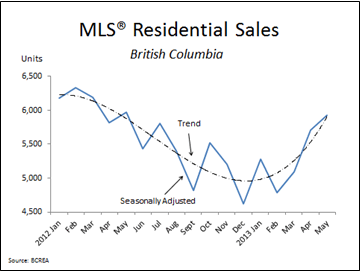
2013-05chartThe British Columbia Real Estate Association (BCREA) reports that a total of 7,664 residential sales were recorded by the Multiple Listing Service® (MLS®) in BC during May, down 0.7 cent from May of 2012. Total sales dollar volume was 2 per cent higher at $4.1 billion.

The average MLS® residential price in the province was $534,013, up 2.7 per cent from a year ago. “BC home sales continued to trend higher in May,” said Cameron Muir, BCREA Chief Economist. “In contrast to slowing demand and moderating prices in 2012, the BC housing market is turning around.” Rising consumer demand combined with inventory levels that remain in check has moved the province’s largest markets into balanced territory. “Home prices have edged higher over the past three months in BC’s large Lower Mainland market,” added Muir.

The MLS® Home Price Composite Index for the lower Mainland was up 0.2 per cent over the past month, and 1.4 per cent over the past three months. Year-to-date, BC residential sales dollar volume was down 12.2 per cent to $14.9 billion, compared to the same period last year. Residential unit sales were down 10.7 per cent to 28,140 units, while the average MLS® residential price was down 1.7 per cent at $530,936.

Watch Cameron Muir of BCREA Video Podcast Here: BC Real Estate Association May Market Update


10 ways to turn off a would-be homebuyer

home-prices-march-hit-largest-20130528-192313-578What a difference a couple of years makes. Back in 2007, homebuyers would be lined up to purchase your house and multiple offers were common place. Today, although we are trending towards a balanced market in Victoria, BC, buyers still have the upper hand and instead of buying, they’re waiting, convinced that housing prices will continue to drop. What’s a smart seller to do in this environment? I found this article from a US real estate source, but the tips and ideas are pertinent to local real estate strategies here in Victoria as well ~ Ingrid.

10 home sales killers
  1. Dirt
  2. Odors
  3. Old fixtures
  4. Wallpaper
  5. Popcorn acoustic ceilings
  6. Too many personal items
  7. Snoopy sellers
  8. Misrepresenting your home
  9. Poor curb appeal
  10. Clutter

We assembled a coast-to-coast SWAT team to address the crisis: Chad Goldwasser of Goldwasser Real Estate in Austin, Texas; Terry Cannon, a buyer’s agent and broker with Oregon Exclusive Buyers Realty in Salem, Ore.; and Julie Dana, the New York-based “home stylist” and co-author of “The Complete Idiot’s Guide to Staging Your Home to Sell.”

They suggest 10 buyer turnoffs that sellers should avoid at all costs.

“If you do all the staging correctly and have a good agent, the house will hopefully only be on the market a few weeks,” Dana says. “Then you can go back to living your life.”

1. Dirt

Hands down, our panel agrees: Nothing turns off a buyer quicker than a dirty house.

“The No. 1 biggest mistake is not getting the home in the best possible condition. That’s huge,” says Goldwasser. “I won’t even represent sellers at this point unless they are fully aware of how important it is to get their home in the absolute best condition that they’ve ever had it in.”

Goldwasser recommends that sellers go the extra mile, from steam-cleaning tile and grout to replacing carpets.

“If the carpets are old and smelly, you should put in new,” he says. “If they’re relatively new, you should at least have them shampooed.”

Cannon agrees that grime can derail any showing.

“The home should be neat and clean and free of all debris,” Cannon says. “If it reeks of cats or the kitchen sinks and counters are so filthy that it almost looks like the food is moving, I won’t even want to come in.”

2. Odors

Buyers, it’s said, buy with their noses. Make sure your home smells fresh and inviting.

“Odors are a big one, especially kitchen odors,” says Dana. “I advise my clients not to cook fried food, fish or greasy food while the house is on the market.”

Some pet owners mistakenly believe pet smells to which they’ve become accustomed help make their abode homey. Nothing could be further from the truth.

“If you’re a dog person, you tend to think everyone else is a dog person,” says Goldwasser. “But the truth is, 50 percent of the population hates dogs and doesn’t want to be near them. “Pets in the home? You have to deal with that.”

Dana advises her clients to eliminate all traces of pets, not just pet odors. It’s important to get rid of pet paraphernalia and have a “pet plan” to make sure the animals are not around when the house is shown.

“Pets in the home? You have to deal with that.”

“A lot of times, people will leave pet items out — dog dishes, cat litter boxes, etc.,” Dana says. “That immediately turns off a buyer because they wonder, ‘What has that animal done in the house?’ Also, some people really don’t like dogs. The minute they walk in and see this big, old dog bowl, they immediately won’t like the house.”

The same rules hold true for smokers: Remove all ashtrays, clean all curtains and upholstery, and consider smoking outdoors while your home is on the market.

“Interestingly, next to the kitchen, the smelliest room in the house is actually the living room,” Dana says. “That’s typically the room that has the most fabric, so that is where odors get absorbed.”

3. Old fixtures

Want buyers to roll their eyes? Leave old fixtures on your doors and cabinets.

“You need to change out old fixtures in your house,” Goldwasser says. “New cabinet hardware and doorknobs will probably cost all of $400 or $500, but it makes a huge difference.”

The same holds true for dated ceiling fans, light fixtures and kitchen appliances.

“Homes that have old fans, lights, ovens, microwaves, ranges and dishwashers can really turn a buyer off,” says Goldwasser. “Sellers will say, ‘Oh, the buyers can take care of that.’ Well, yes they can, but it’s going to impede you from getting the highest price possible for your home.”

4. Wallpaper

Your grandmother may have had it in every bedroom. Your mom may have loved it as a room accent. But today’s buyer wants no part of wallpaper.

“Wallpaper is a definite no-no,” Dana says.

Wallpaper is a pain to remove and simply adds another chore to a buyer’s to-do list, Dana says.

“Wallpaper is extremely personalized. You’ve spent hours looking over books to pick out the wallpaper you want,” she says. “What are the odds that the person walking in the door will also like that wallpaper that you picked out?”

5. Popcorn acoustic ceilings

Times change, and with them home decor styles. Acoustic popcorn ceilings, once the must-have for fashionable homes in the ’60s and ’70s, now badly date your space.

If you can’t stomach the cost or the mess to remove the overhead popcorn, be prepared to credit a buyer in certain markets in order to close a sale.

“The popcorn acoustic ceiling is a major, major turnoff to buyers these days,” says Goldwasser.

6. Too many personal items

Psychologically, when buyers tour a home, they’re trying it on to see how it fits, just as they would a skirt or a pair of pants. If your house is cluttered with too many personal items, it’s like the buyer is trying on those clothes with you still in them. A fit is unlikely.

“Anything that makes your house scream ‘you’ is what you don’t want,” Dana says. “I tell all my clients that how we decorate to live and how we decorate to sell are different, and right now, we’re decorating to sell.”

Sellers should try to eliminate personal items, including family photos, personal effects and even unique colors, she says.

“As soon as you have family photos, buyers get very distracted. ‘Oh, did I go to school with him? What do their children look like?'” she says. “Suddenly, you’re selling your family, and you’re not selling the home.”

If you really want to hook a buyer, Dana offers a tip: “I try to place a mirror strategically so that people can actually see themselves in the home, so they can actually picture themselves living there.”

7. Snoopy sellers

Realtors and buyers alike generally bristle when the seller greets them at the door for a showing.

“It’s so annoying,” Goldwasser says. “They will want to walk around with the potential buyer and put in theirand two cents’ worth. It’s not good. Normally, there are one out of 10 sellers where it’s OK to have them there, and that’s because they know what is up with the property and how everything works.”

“I tell all my clients that how we decorate to live and how we decorate to sell are different.”

Goldwasser makes a point to shoo his sellers away from showings when he’s the listing agent.

“They like to think they know what they’re doing, and that’s fine,” he says. “But when you’ve sold thousands of homes and you have a system, you know how to get people the maximum value for their home. That’s why they hire you, right?”

8. Misrepresenting your home

Misrepresenting your house online in the multiple listing service is a sure way to really upset buyers and their Realtors.

One of Cannon’s buyers loved a home she saw online. When he drove by to take a look, he was surprised to find acres of ramshackle mobile homes across the street.

“Sellers are going to paint the best picture they can,” he says. “Some listings I’ve looked at and wondered how in the world they got that gorgeous photo without showing all the junk that’s around it. When you get there, you wonder why didn’t they just be upfront?”

9. Poor curb appeal

Much is made of curb appeal, and for good reason: It’s your home’s handshake, the critical first impression that lasts with most buyers.

“You have to totally trim and edge your yard to get it into the most immaculate condition you can,” Goldwasser says. “It’s a big mistake to not freshly mulch the beds and trim the trees. Every little detail counts.

“To not power-wash the exterior or leave mud dauber and wasp and bird’s nests in your eaves and above your doors? You’ve got to be a fool to do that.”

10. Clutter

Whether inside or out, less is more when it comes to clutter.

“I usually start in the closets,” Dana says. “Your closets should be half-full with nothing on the floor. Why? Because most people looking for a house have outgrown their previous house. Showing them that you’ve still got room to grow gives them a reason to buy.”

Kitchens and built-in bookshelves should showcase spaciousness by following the rule of three. For kitchens, there should be no more than three countertop appliances. Meanwhile, bookshelves should be divided into thirds: one-third books, one-third vases and pictures, and one-third empty.

The home office should be very generic so any type of professional can imagine living there, Dana says.

“Otherwise, it can be a distraction: ‘What does he do for a living? How much money does he make?'” she says.

Dana’s tip for toddler parents is to pack away extraneous “kiddie litter” and keep a laundry basket handy.

“When you get that phone call one hour before a showing, toss everything in that basket and take it to the car with you and your kids, and you’re all set,” she says.

Bankrate.comBy Jay MacDonald | Bankrate.com


SECOND QUARTER STRENGTH IN GREATER VICTORIA REAL ESTATE MARKET

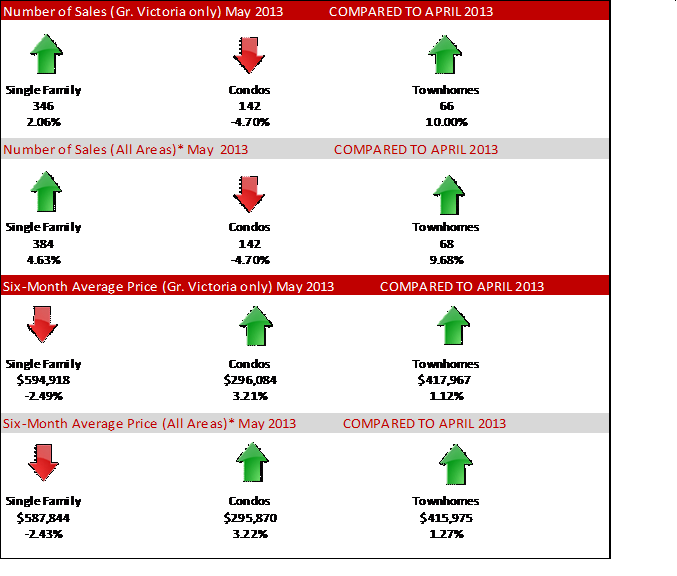
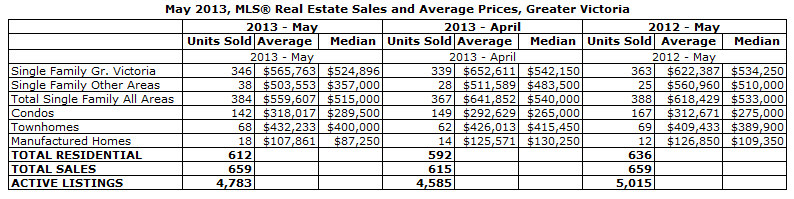
Greater Victoria real estate sales for May are identical to the same period one year ago: 659 properties sold on the MLS® System. image003

“We are continuing to see improved consumer confidence in the marketplace,” says Shelley Mann, President of the Victoria Real Estate Board. “Our Members are much busier with showings and writing offers, but say they are working harder to help their clients satisfy stricter lending rules. This quarter is definitely much stronger than the first quarter of 2013.”

Buyers remain price sensitive. “Homeowners who are pricing their properties competitively, not expecting the higher sale prices of 2008, are selling their homes,” Mann says. “With 4,783 active listings, buyers have plenty to choose from. With higher sales volumes and a reasonable inventory level, Greater Victoria continues to edge towards a balanced market.”

There were 384 single family homes sold in May at a median price of $515,000, down 3.4% over May 2012 at $533,000. Condominium sales were 142 at a median price of $289,500 and 68 townhomes sold at a median price of $400,000. “With average and median prices fluctuating on a monthly basis, it’s more important than ever for consumer to consult a REALTOR®,” Mann says.

Total Waterfront Single Family Dwellings sold:                    18, up 3 over May 2012

Total Non-waterfront Single Family Dwellings sold:          366, down 7 over May 2012

Single Family Dwellings sold over $1 million:                       18 (2 over $2 million)

statisticalsummary

Summary Report and Graphs 

Monthly Sales Summary
Average Selling Price Graphs
Active Listings, New Listings and Sales Graphs

While the use of average price information can be useful in establishing trends when applied over a period of time, e.g. six months or longer, the Victoria Real Estate Board cautions that an average price does not indicate the actual value of a property in a particular neighbourhood. Those requiring specific information on property values in their area should contact a REALTOR®.